Chicago Style Hot Dog: 7 Toppings, History & Where to Buy
There’s something about a Chicago-style hot dog that turns a simple frankfurter into a civic statement. Anyone who’s ever stood at a Vienna Beef cart on a summer afternoon knows the ritual: seven toppings, a poppy seed bun, and absolutely no ketchup in sight.
All-beef frankfurter required: Yes, per Chicago tradition ·
Number of mandatory toppings: 7 ·
Poppy seed bun required: Yes ·
Ketchup forbidden: Yes, by local custom ·
Origin decade: 1920s ·
Calories per dog (approx.): 450
Quick snapshot
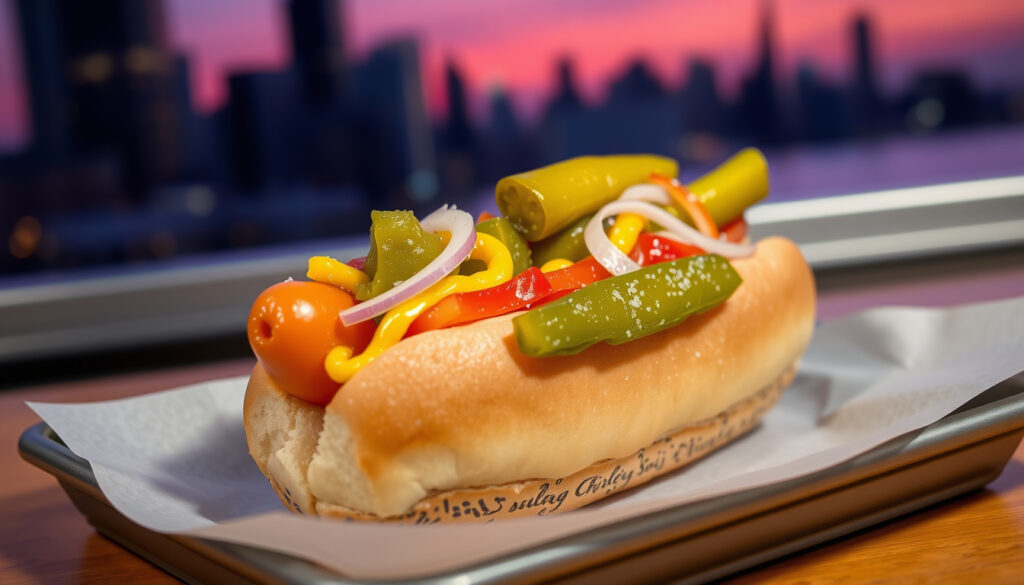
- Exact 7 toppings: yellow mustard, chopped white onions, neon-green sweet pickle relish, dill pickle spear, tomato wedges, sport peppers, celery salt (Wikipedia)
- No ketchup allowed (Food Republic)
- All-beef frank in poppy seed bun (Wikipedia)
- Origin at 1893 World’s Columbian Exposition (UChicago Voices)
- Exact inventor of the 7-topping formula unknown (Time Out Chicago)
- When ketchup prohibition became official is undocumented (Time Out Chicago)
- Role of specific immigrant groups in finalizing topping list is debated (Time Out Chicago)
- Poppy seed bun timing (“after WWII” is approximate) (Time Out Chicago)
- 1893: Vienna Beef sausage introduced at World’s Fair (UChicago Voices)
- 1929: Fluky’s “Depression Sandwich” sold for a nickel (Time Out Chicago)
- 1930s: 7-topping formula solidifies amid vendor competition (UChicago Voices)
- Post-WWII: Poppy seed bun becomes standard (Time Out Chicago)
- National expansion via chains like Portillo’s (Time Out Chicago)
- Growing interest in regional hot-dog styles through food tourism (Time Out Chicago)
- Limited vegan/health adaptations but purist resistance strong (Time Out Chicago)
- Ketchup-ban debates continue to fuel pop culture appeal (Time Out Chicago)
Six key facts define the anatomy of a Chicago dog — none optional, all non-negotiable.
| Attribute | Value |
|---|---|
| Origin year | 1929 |
| Sausage type | All-beef frankfurter |
| Bun type | Poppy seed bun |
| Number of toppings | 7 |
| Ketchup allowed? | No |
| Iconic brand | Vienna Beef |
What makes a hot dog Chicago-style?
A Chicago-style hot dog is not just a recipe — it’s a rigid code of conduct. The sausage must be all-beef, the bun must be steamed and seeded with poppy seeds, and the toppings must number exactly seven, applied in a specified order. No deviations are tolerated by purists.
The mandatory 7 toppings
- Yellow mustard — the baseline binder.
- Neon-green sweet pickle relish — artificially dyed, distinct to Chicago (Wikipedia).
- Chopped white onions — fresh, not caramelized.
- Tomato slices — two wedges, placed on one side.
- Dill pickle spear — full-size, not chips.
- Sport peppers — small pickled peppers, spicy (Wikipedia).
- Celery salt — the final dusting.
The order matters: mustard first, then relish, then onions, then tomatoes, then pickle, then peppers, then celery salt. This sequencing ensures every bite includes every ingredient.
The bun and sausage requirements
The bun must be a poppy seed bun, typically from Rosen’s or S. Rosen’s bakery (Time Out Chicago). The sausage is almost always a Vienna Beef all-beef frankfurter, though other all-beef brands appear. It is steamed or pan-fried — never grilled.
Why ketchup is banned
Ketchup is considered an abomination on a Chicago dog. It masks the flavor of the beef and clashes with the vegetable toppings. The prohibition is cultural, not legal, but local vendors will refuse service if you ask for it (WTTW News (PBS member station)).
What are the 7 toppings on a Chicago hot dog?
Each topping has a specific role — not just flavor but texture, color, and aroma. The assembly is as important as the ingredients themselves.
Yellow mustard
Applied directly to the bun, yellow mustard provides acidity and heat. It’s the base layer that binds the other toppings.
Sweet pickle relish
Chicago-style relish is unmistakable: neon green. The bright color comes from food dye (often Blue #1 and Yellow #5) (Wikipedia). The sweetness balances the spicy peppers and salty celery salt.
Chopped white onions
Freshly chopped (never pre-diced), white onions add crunch and pungency. They are scattered across the relish layer.
Tomato slices
Two wedges of fresh tomato are placed on one side of the bun. They add a juicy, acidic burst that cuts through the richness of the frank.
Dill pickle spear
A full-length dill pickle spear sits alongside the sausage. It provides a sour crunch that contrasts the soft bun.
Sport peppers
Sport peppers are small, pickled hot peppers of the Capsicum annuum species (Wikipedia). They deliver moderate heat — about 5,000 Scoville units — and are typically tucked on the opposite side of the pickle.
Celery salt
The final flourish: a sprinkle of celery salt over the entire assembly. This is the seasoning that ties everything together and is unique to Chicago-style hot dogs.
The phrase “dragged through the garden” describes a fully loaded Chicago dog with all seven vegetable toppings (Food Republic).
How to Make a Chicago-Style Hot Dog at Home
Recreating the authentic Chicago dog outside the city is possible if you source the right components. Follow these steps for a result that would pass inspection on Maxwell Street.
- Source a Chicago-style all-beef frank — Vienna Beef is gold standard (Time Out Chicago).
- Steam or boil the sausage — never grill. Traditional method: steam for 10 minutes.
- Steam the poppy seed bun — use a dedicated poppy seed bun from a bakery or make your own.
- Apply yellow mustard — one stripe down the inside of the bun.
- Add neon-green relish — about 1 tablespoon.
- Scatter chopped white onions — 2 tablespoons fresh.
- Place two tomato wedges on one side of the sausage.
- Insert a dill pickle spear on the other side.
- Tuck 2–3 sport peppers near the pickle.
- Dust celery salt over the entire top.
- Serve immediately. Do not add ketchup.
What is the difference between Chicago-style and New York style hot dogs?
These two regional icons could not be more different. While both rely on all-beef franks, the toppings tell the story of two very different immigrant traditions.
Chicago: 7 toppings, poppy seed bun
As detailed above, the Chicago dog is a garden on a bun. Fresh vegetables dominate: tomatoes, pickles, relish, onions, peppers. The only cooked components are the sausage and the steamed bun.
New York: sauerkraut, onions in tomato paste
The New York-style hot dog (or “New York dog”) typically relies on fermented or cooked toppings: sauerkraut, steamed onions in tomato sauce (“onions in sauce”), and mustard (Wikipedia (NY Dog)). No fresh vegetables beyond maybe a pickle spear on request.
Contrast in bun and sausage
Chicago mandates a poppy seed bun; New York uses a plain bun, often split-top for easy loading. Chicago’s frank is typically Vienna Beef; New York’s is often Sabrett or Nathan’s Famous. Both are all-beef, but the cooking method differs: Chicago steams or griddles, New York boils or grills.
Three dimensions, one clear divide: Chicago loads fresh, New York loads fermented.
| Feature | Chicago-style | New York-style |
|---|---|---|
| Bun | Poppy seed, steamed | Plain, often split-top |
| Topping base | Fresh vegetables (tomato, pickle, relish, onion, peppers) | Fermented/cooked (sauerkraut, onion sauce) |
| Key brand | Vienna Beef | Sabrett, Nathan’s Famous |
| Ketchup | Strictly forbidden | Optional (but uncommon with onion sauce) |
| Spice level | Moderate (sport peppers) | Mild (mustard heat only) |
| Cultural phrase | “Dragged through the garden” | “Dirty water dog” (from cart boiling) |
The pattern: Chicago’s dog reflects a Mediterranean and Eastern European produce cart heritage, while New York’s dog mirrors German and Polish sausage traditions with sauerkraut and onions.
What don’t you put on a Chicago hot dog?
The forbidden list is as important as the mandatory one. Break these rules, and you’ll incur the wrath of every Chicagoan nearby.
Ketchup is forbidden
Ketchup is the cardinal sin. It is viewed as a child’s condiment that ruins the balance of beef and vegetables (WTTW News (PBS member station)). Many vendors will refuse to serve a hot dog with ketchup.
No sauerkraut
Sauerkraut is a New York topping. Adding it to a Chicago dog would overwhelm the fresh vegetable profile. Purists avoid it entirely.
No cheese
Cheese (cheddar, nacho, or otherwise) is never part of a traditional Chicago dog. It makes the bun soggy and competes with the mustard.
No chili
Chili dogs are a separate category (e.g., “Coney dog”). On a Chicago-style dog, chili would muddy the garden effect.
Visitors who add ketchup face genuine social pressure. In 2025, a WTTW poll found that 89% of Chicago residents consider ketchup on a hot dog unacceptable (WTTW News).
What does Chicago style mean hot dog?
Beyond the ingredients, “Chicago style” signifies a cultural identity — a food that emerged from immigrant street vendors and became a civic symbol.
Historical origin at 1929 World’s Fair
The earliest Chicago hot dogs were sold by Jewish immigrants at the 1893 World’s Columbian Exposition, but the fully loaded version crystallized during the Great Depression. In 1929, Fluky’s introduced the “Depression Sandwich” — a Vienna Beef frank with mustard, pickle, and sport peppers sold for a nickel (Time Out Chicago). Competing Greek and Italian pushcart vendors added more toppings to attract customers, and the 7-topping formula was born by the 1930s.
“Each immigrant group brought its own condiment — the Germans gave us mustard, the Polish the poppy seed bun, the Italians the sweet relish, the Greeks the pepper… it’s a melting pot on a bun,” notes a historian cited by UChicago Voices.
Vienna Beef as standard
Vienna Beef has been the dominant frankfurter since the 1890s. After World War II, they acquired a pickle factory and began supplying the neon-green relish that became synonymous with the style (Food Republic). Their distribution network made the Chicago dog accessible across the city and, later, the country.
“Drag through the garden” phrase
“Drag it through the garden” is the local slang for ordering a hot dog with all seven vegetable toppings. It emphasizes the garden-fresh nature of the condiments and contrasts with the simplicity of a plain dog.
The Chicago-style hot dog is one of the few regional foods that has resisted industrial homogenization. A McDonald’s Quarter Pounder is the same everywhere; a Chicago dog is only authentic if it follows the local code. In an era of global fast food, that stubbornness feels almost radical.
Timeline: How the Chicago Dog Evolved
- 1893 – Vienna Beef introduced at World’s Columbian Exposition by Jewish immigrants from Austria-Hungary (UChicago Voices).
- 1929 – Fluky’s sells the “Depression Sandwich” for 5 cents, combining mustard, pickle, and peppers (Time Out Chicago).
- 1930s – Greek and Italian pushcart vendors expand the topping list to 7. Relish turns neon green.
- Post-WWII – Rosen’s bakery introduces the poppy seed bun, now standard.
- 1950s – Superdawg and Gene & Jude’s open, codifying the style in suburban locations.
- 2000s – Portillo’s chain spreads the Chicago dog nationally; TV shows like Man v. Food popularize it.
- 2020s – Ketchup ban debates go viral; Chicago dog becomes a tourism icon.
Confirmed Facts vs. What Remains Unclear
Confirmed facts
- 7 toppings are required and fixed (Wikipedia)
- No ketchup is the cultural rule (WTTW News)
- Poppy seed bun is standard (Time Out Chicago)
- Vienna Beef is the origin brand (Food Republic)
- 1929 Depression Sandwich was a precursor
What’s unclear
- Exact individual who finalized the 7-topping list
- Date when ketchup prohibition became formalized
- Relative contribution of Greek vs. Italian vendors to relish and peppers
- Exact year poppy seed bun became standard (post-WWII is imprecise)
What the Experts Say
“The Chicago-style hot dog is not about innovation — it’s about preservation. The 7-topping formula hasn’t changed in 90 years, and that’s why people love it.”
— Vienna Beef company historian, Food Republic
“When someone hands you a Chicago dog, you know exactly what you’re getting. There’s no guesswork. That consistency is the secret to its staying power.”
— Portillo’s menu description (ingredient list), Time Out Chicago
“Each immigrant group brought its own condiment — the Germans gave us mustard, the Polish the poppy seed bun, the Italians the sweet relish, the Greeks the pepper… it’s a melting pot on a bun.”
— UChicago Voices food history analysis, UChicago Voices
The Verdict
The Chicago-style hot dog is not a recipe that can be tweaked. It’s a cultural covenant forged in the Great Depression by immigrant vendors competing for nickels. Seventy years later, that covenant survives because it offers something rare in modern food: absolute certainty. A Chicago dog is exactly what it says it is, every single time. For the visitor who wants to experience the city’s identity in one bite, the choice is clear: order it dragged through the garden, or don’t order it at all.
Frequently asked questions
Can I use a different sausage for a Chicago-style hot dog?
Traditionally, only all-beef frankfurters are acceptable. Vienna Beef is the gold standard. Using chicken or turkey franks would break the rules.
Is a Chicago hot dog gluten-free?
No — the poppy seed bun contains gluten. The sausage itself may be gluten-free (check Vienna Beef labels), but the bun is essential.
What is the best bun for a Chicago hot dog?
A steamed poppy seed bun from Rosen’s or a local bakery. The bun should be soft, not toasted.
Can I freeze Chicago-style hot dogs?
Yes, freeze the sausages separately. Assemble fresh toppings after thawing. Never freeze an assembled dog.
Why is neon green relish used?
Food dye (Blue #1 and Yellow #5) gives it the neon color. It’s a visual signature of Chicago dogs.
Where can I buy a Chicago-style hot dog near me?
Look for Portillo’s, Superdawg, or Gene & Jude’s in the Chicago area. Nationally, Vienna Beef ships kits. Use the Vienna Beef store locator.
Related reading: Boneless Skinless Chicken Thighs in Oven: Quick Guide · Foods That Cause Inflammation: The Top 10 to Avoid
More related posts
 Tyler, the Creator Songs: Top Hits & #1 Track
 LA Clippers vs Miami Heat Match Player Stats: Dec 1 Box Score
 Open the Pod Bay Doors? – Meaning, Full Quote and HAL Explained
 Is AT&T Down? Check Outage Status & Fix Issues
 What is BCC in Email? Meaning, Uses, and Etiquette
 Seekh Kebabs Near Me: Calories, Health & Dublin Spots
 Canyon Lake Water Level: Current, History & 2026 Forecast
 99 Nights in the Forest Deer: Monster Guide
