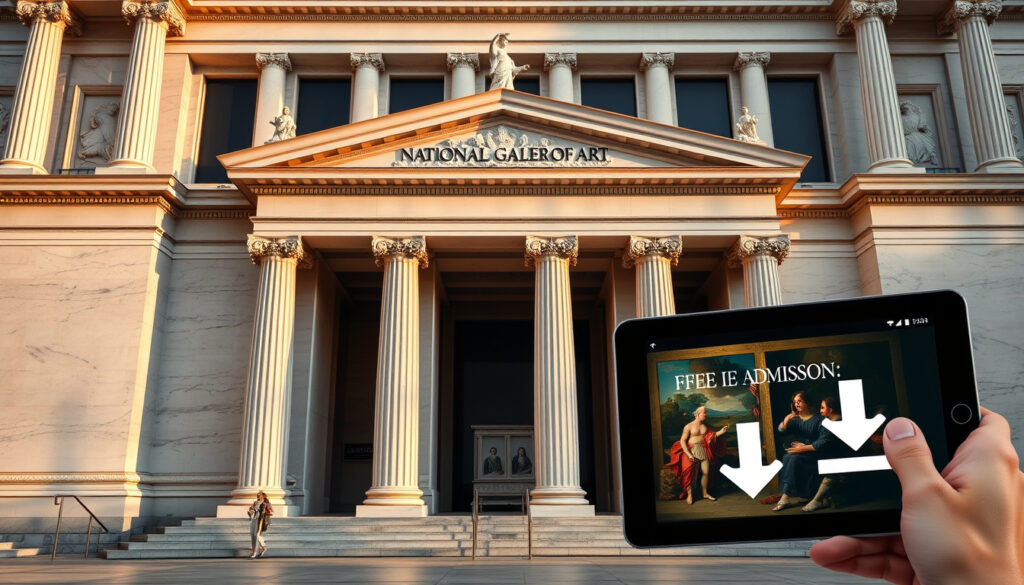
National Gallery of Art: Masterpieces, Free Entry & Downloads
Few museums make you feel like you’ve stumbled into a secret the way the National Gallery of Art does. Standing on the National Mall in Washington D.C., it holds over 150,000 works—and lets you walk through the doors without spending a dime. Whether you’re hunting for a Leonardo da Vinci or just want to download a high-resolution masterpiece for free, this guide walks you through what matters most.
Total artworks in collection: over 150,000 ·
Open access images available: nearly 60,000 ·
Annual visitors (approx.): over 4 million ·
Location: National Mall, Washington D.C. ·
Year founded: 1937
Quick snapshot
- Admission to all permanent collections is free (National Gallery of Art (official policy))
- Nearly 60,000 images available for open-access download (National Gallery of Art (open access page))
- Ginevra de’ Benci is the only Leonardo da Vinci in the Americas (National Gallery of Art (collection record))
- Which single painting is universally considered the saddest or most beautiful remains subjective
- Exact annual visitor numbers for the National Gallery of Ireland vary across sources
- 1937: National Gallery of Art established in Washington D.C.
- 1941: West Building opened to the public
- 1978: East Building opened, designed by I.M. Pei
- 2023: Open access initiative expanded to nearly 60,000 images
- Open access database continues to grow; check the NGA site for latest additions
- Special exhibitions rotate regularly—plan ahead to avoid missing ticketed shows
Six key facts tell the story of what you’re walking into.
| Field | Value |
|---|---|
| Founding year (NGA Washington) | 1937 |
| Open access images available | Nearly 60,000 |
| Total visitors annually (NGA Washington) | Over 4 million |
| Admission fee (both galleries) | Free for general collection |
| Famous work at NGA Washington | Ginevra de’ Benci by Leonardo da Vinci |
| Famous work at NGI Dublin | The Taking of Christ by Caravaggio |
What is the most famous piece in the National Gallery of Art?
Key contenders for the title of most famous painting
Ask five art lovers to name the single most famous painting at the National Gallery of Art, and you’ll get five different answers. But one work holds a trump card no other can match.
- Ginevra de’ Benci by Leonardo da Vinci — the only da Vinci painting in the Americas — often claims the top spot. Painted around 1474, it’s a portrait of a Florentine teenager with an unsettlingly direct gaze (National Gallery of Art (collection record)).
- Self-Portrait by Vincent van Gogh — a visceral, swirling image painted in 1889 — is another crowd favorite (National Gallery of Art (collection record)).
- The Japanese Footbridge by Claude Monet — one of the artist’s late-career pond scenes — anchors the impressionist gallery (National Gallery of Art (collection record)).
Visitor favorites and curatorial picks
The museum’s own “must-sees” guide prioritizes variety over rank: intimate portraits, action paintings, even a 14-foot-tall rooster sculpture (National Gallery of Art (official must-sees page)). The implication: you don’t have to pick one masterpiece. You can sample the whole collection.
The catch: Ginevra de’ Benci wins the technical crown because of its rarity, but emotional resonance belongs to whichever painting stops you mid-stride.
What are some must-see pieces at the National Gallery of Ireland?
Highlights from the Irish collection
Across the Atlantic in Dublin, the National Gallery of Ireland holds its own arsenal of masterpieces. The undisputed heavyweight: Caravaggio’s The Taking of Christ, painted in 1602. It was lost for almost 200 years before being rediscovered in 1990 in a Dublin residence (National Gallery of Ireland (collection highlight)).
- Jack B. Yeats — brother of the poet — represents Irish modern art with emotionally charged canvases (National Gallery of Ireland (highlights page)).
- Vermeer’s Woman Writing a Letter (c. 1665) is a quiet, luminous highlight of the European collection (National Gallery of Ireland (collection record)).
European masterpieces on display
The gallery’s holdings span Italian Renaissance to French Impressionism. A single visit could take you from a 17th-century Dutch interior to a vibrant Yeats landscape — the range is deliberate. Why this matters: if you’re planning a trip to Dublin, the National Gallery of Ireland offers a concentrated hit of European art history in a city-center location, all for free general admission.
Is admission to the National Art Gallery in Dublin free?
Admission policies and free entry details
Yes — general admission to the National Gallery of Ireland is free. No ticket required. The permanent collection is open to everyone (National Gallery of Ireland (visitor information)). The same is true for the National Gallery of Art in Washington D.C., which states it is “open to the public 361 days a year, free of charge” (National Gallery of Art (official policy)).
“General admission to the permanent collection is free.”
National Gallery of Ireland (visitor information)
Special exhibitions that may require tickets
While permanent collections at both institutions are free, some temporary or ticketed exhibitions carry a fee. At the National Gallery of Art in Washington, special exhibitions may require a pass, though the permanent wings remain no-cost (National Gallery of Art (visit page)). At the National Gallery of Ireland, similar policies apply for ticketed shows. The trade-off: you pay only if you want the blockbuster exhibit; the core collection is always waiting.
What is the saddest painting of all time?
Paintings known for their melancholy themes
Art history is full of heartbreak on canvas. Three works consistently surface in discussions of the “saddest” painting:
- The Night Cafe by Vincent van Gogh (1888) — van Gogh himself called it a place where “one can ruin oneself, go mad or commit a crime” (National Gallery of Art (collection record)).
- Christina’s World by Andrew Wyeth (1948) — a woman crawls across a field, isolated and frail, at the Museum of Modern Art (Museum of Modern Art (collection record)).
- The Scream by Edvard Munch (1893) — existential despair in a single figure, held by the National Museum of Norway (National Museum of Norway (collection record)).
Emotional impact and historical context
Each of these paintings taps into a specific flavor of sadness: van Gogh’s is atmospheric dread, Wyeth’s is physical vulnerability, Munch’s is psychic terror. None of them hang at the National Gallery of Art, but the question itself reveals something: people want to find emotional weight in art, and the gallery’s collection includes works that can deliver it — you just have to look past the “masterpiece” label.
What is considered the most beautiful piece of art?
Candidates for the most beautiful painting
Beauty is subjective, but some paintings keep showing up on “most beautiful” lists.
- The Birth of Venus by Sandro Botticelli (c. 1485) — frequently named the most beautiful painting in surveys, housed at the Uffizi Gallery in Florence (Uffizi Gallery (collection record)).
- Mona Lisa by Leonardo da Vinci (1503) — celebrated for its technical beauty and the mystery of her expression, at the Louvre (Louvre Museum (collection record)).
Public and critical perspectives on beauty in art
Different schools of art hold different criteria. Renaissance painters prized balance and naturalism; Impressionists valued light and color; modernists broke form entirely. The pattern: beauty isn’t a fixed quality — it’s a conversation between the work and the viewer. The National Gallery of Art’s collection participates in that conversation across centuries, which is exactly why no single answer feels final.
How to make the most of your visit
Plan your route — two buildings, one garden
The National Gallery of Art’s campus is split: the West Building (classic European art, Italian Renaissance to 19th century) and the East Building (modern and contemporary, plus the tower galleries). Between them sits the Sculpture Garden (National Gallery of Art (visit page)). The museum’s official must-sees guide notes: “Only have an hour? That’s enough time…” — and recommends you visit artworks “in any order you choose” (National Gallery of Art (must-sees page)).
“Two buildings, one garden — yours to explore and always free.”
National Gallery of Art (official visit page)
- West Building: da Vinci, Rembrandt, Vermeer, Monet, van Gogh
- East Building: Calder mobiles, Rothko, Pollock, Warhol
- Sculpture Garden: outdoor installations, seasonal ice skating rink
A simple three-step visit
- Start in the West Building for Renaissance and European masterpieces.
- Cross to the East Building for modern and contemporary highlights.
- Finish in the Sculpture Garden, then check the open access database for digital souvenirs.
Open access downloads — a hidden superpower
The National Gallery of Art makes nearly 60,000 images available as free, high-resolution downloads. You can use them for projects, prints, or just browsing from home (National Gallery of Art (open access page)). This is one of the largest institutional open-access programs in the world.
Art lovers anywhere with internet access can now own a digital copy of Ginevra de’ Benci. That changes who gets to experience the collection — not just those who can travel to Washington.
Practical details (hours, coat check, food)
- Hours: 10:00 a.m. to 5:00 p.m. daily; closed December 25 and January 1 (National Gallery of Art (what to expect))
- Admission: always free — no ticket needed for general collection
- Coat check and bag storage: available near the entrances
- Food: the Cascade Cafe (West Building) and national dining options nearby (National Gallery of Art (eating options))
- Photography: allowed for personal, non-flash use in permanent collection galleries
Related reading: Best Travel Destinations 2025 · Greek Gods and Goddesses: Complete List and Powers
nga.gov, nationalgallery.org.uk, nationalgallery.org.uk, nga.gov, gallery.ca, gao.gov, nationalgallery.sg, nga.gov, youinlondon.com, nationalgallery.org.uk
Frequently asked questions
What are the opening hours of the National Gallery of Art?
The museum is open daily from 10:00 a.m. to 5:00 p.m., with closures only on December 25 and January 1 (National Gallery of Art (what to expect)).
Are photography and video allowed inside the museum?
Personal, non-flash photography is permitted in the permanent collection galleries. Video and tripod use may require prior permission (National Gallery of Art (rules and regulations)).
Is there a coat check or bag storage available?
Yes, complimentary coat and bag check is available at both the West and East Building entrances (National Gallery of Art (visit page)).
Does the National Gallery of Art have a cafe or restaurant?
Yes, the Cascade Cafe in the West Building offers casual dining, and the East Building has an espresso bar. The Sculpture Garden also has seasonal concessions (National Gallery of Art (eating options)).
Can I purchase tickets for special exhibitions online?
Yes, for exhibitions that require tickets, advance online purchase is available through the museum’s official site. Permanent collection remains free without tickets (National Gallery of Art (visit page)).
How many open access images can I download for free?
Nearly 60,000 images from the collection are available as free high-resolution downloads through the museum’s open access program (National Gallery of Art (open access page)).
Is admission to the National Gallery of Ireland also free?
Yes, general admission to the permanent collection of the National Gallery of Ireland in Dublin is free (National Gallery of Ireland (visitor information)).
Where is the National Gallery of Art located?
It sits on the National Mall between 3rd and 9th Streets at Constitution Avenue NW, Washington D.C. (National Gallery of Art (visit page)).
For anyone planning a trip to Washington D.C. or Dublin, the choice is simple: prioritize the permanent collection first, then check if a special exhibition justifies the ticket price. The implication: both galleries offer free access to their core holdings, making them among the most accessible major art museums in the world.
More related posts
 How to Get Rid of Ringworm: Fast Treatment & Contagion
 55 kg to lbs – Exact Conversion to 121.25 Pounds
 Seahawks vs Atlanta Falcons Match Player Stats & Box Score 2025
 AT&T Prepaid Customer Service: Phone Numbers & Chat
 New Orleans Pelicans Standings – 2024-25 Final Record and Rank
 What Is a Broker? Definition, Types, How They Make Money
 Open the Pod Bay Doors? – Meaning, Full Quote and HAL Explained
 When Does Gen Alpha Start? 2010 or 2012 Key Differences
