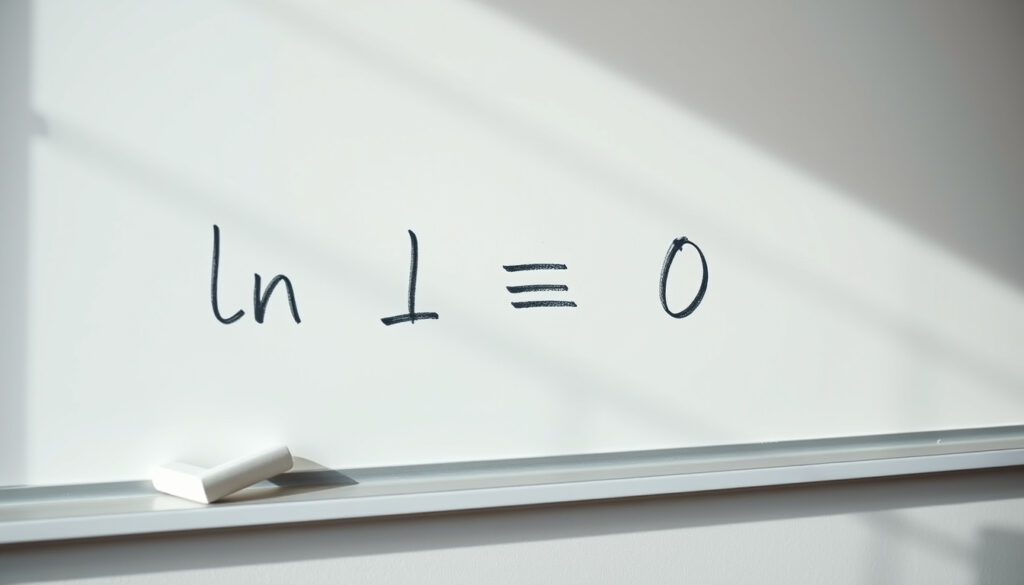
What is ln(1)? Understanding the Natural Logarithm of 1
If you’ve ever stared at “ln(1)” on a calculator and wondered why the answer is always zero, you’re not alone. It’s one of those math facts that feels too neat to be true — yet it’s the key that unlocks how logarithms and exponentials actually work.
ln(1): 0 ·
e^0: 1 ·
ln(e): 1 ·
ln(0): undefined (approaches -∞) ·
ln(1/2): -ln(2) ≈ -0.693
Quick snapshot
- ln(1) = 0 (Wikipedia (encyclopedic reference))
- ln(e) = 1 (Wikipedia (encyclopedic reference))
- ln(0) is undefined in real numbers (Wolfram MathWorld (mathematical reference))
- Complex logarithm of 1 can have multiple values (2πi k) (Wikipedia (encyclopedic reference))
- ln(-1) in complex numbers is iπ + 2πi k (Wikipedia (encyclopedic reference))
- Natural logarithm concept formalized in 17th century by John Napier (Wikipedia (encyclopedic reference))
- ln(1)=0 is a timeless identity — no date dependency (Wikipedia (encyclopedic reference))
- Use ln(1)=0 as a building block for solving exponential equations
- Apply logarithm properties to simplify expressions
| Expression | Value |
|---|---|
| ln(1) | 0 |
| e^0 | 1 |
| ln(e) | 1 |
| ln(0) | Undefined |
| ln(1/2) | -0.693147 |
| ln(2) | 0.693147 |
What is ln(1) equal to?
Definition of natural logarithm
The natural logarithm, denoted ln(x), is the logarithm with base e, where e ≈ 2.71828. As Wolfram MathWorld (mathematical reference) explains, ln(x) is the inverse of the exponential function e^x. This means:
- e^{ln(x)} = x for x > 0
- ln(e^x) = x for all real x
Direct evaluation of ln(1)
To find ln(1), ask: “e raised to what power equals 1?” Since any nonzero number raised to the power 0 equals 1, we have e^0 = 1. By the inverse relationship, ln(1) must be 0. Wikipedia (encyclopedic reference) confirms this directly: “The natural logarithm of 1 is 0, since e^0 = 1.”
Why the value is exactly 0
The integral definition of the natural logarithm provides another perspective. Wolfram MathWorld (mathematical reference) defines ln(a) = ∫_1^a (1/x) dx for a > 0. When a = 1, the integral runs from 1 to 1 — an interval of zero width — so the area is 0. This geometric interpretation reinforces the algebraic result.
The identity ln(1)=0 is not a coincidence — it’s a direct consequence of the zero exponent law (b^0 = 1) and the definition of logarithms as inverse functions. For students learning calculus, this single value anchors the entire logarithmic scale.
The implication: ln(1)=0 is the simplest nontrivial value of the natural logarithm, and it serves as the reference point from which all other logarithmic values are measured.
Why is ln(1) equal to zero?
The inverse relationship with exponentiation
Logarithms and exponentials are inverse functions. Math Insight (educational resource) explains that a logarithm undoes exponentiation. If e^x = 1, then taking the natural log of both sides gives ln(e^x) = ln(1). Since ln(e^x) = x, we get x = ln(1). And we already know x = 0 from e^0 = 1.
Proof using exponential function
The proof is straightforward:
- Start with e^0 = 1 (zero exponent law)
- Apply ln to both sides: ln(e^0) = ln(1)
- Since ln(e^x) = x, the left side simplifies to 0
- Therefore, ln(1) = 0
Wolfram MathWorld (mathematical reference) confirms that ln(1)=0 is consistent with the equation e^x = 1 having the unique solution x = 0.
Graphical interpretation
The graph of y = ln(x) passes through the point (1, 0). This is the x-intercept of the logarithmic curve. For x < 1, ln(x) is negative; for x > 1, ln(x) is positive. The point (1, 0) is the exact boundary where the function crosses from negative to positive values.
This graphical interpretation only works for positive x. The natural logarithm is undefined for x ≤ 0 in the real-number system, which is why the curve never extends to the left of the y-axis.
What this means: the point (1, 0) is the natural logarithm’s “home base” — the one input where the output is zero, making it the reference for all other logarithmic calculations.
What is a Logarithm?
Definition of logarithm
A logarithm answers the question: “To what exponent must the base be raised to produce a given number?” Wikipedia (encyclopedic reference) defines it formally: log_b(a) = c means b^c = a. For natural logarithms, the base is e, so ln(x) = c means e^c = x.
Base e vs common log
The natural logarithm (ln) uses base e, while the common logarithm (log) uses base 10. Math Insight (educational resource) notes that ln(x) is frequently denoted as log_e(x). Both follow the same properties, but natural logarithms are preferred in calculus because the derivative of ln(x) is 1/x — a uniquely simple result.
Natural logarithm history
The abbreviation “ln” comes from the Latin logarithmus naturalis, as BetterExplained (educational blog) explains. John Napier developed the concept of logarithms in the early 17th century, though the natural logarithm as we know it was refined later by mathematicians like Leonhard Euler, who popularized the constant e.
The pattern: logarithms transform multiplication into addition — log(xy) = log(x) + log(y) — which made them indispensable for astronomers and navigators before electronic calculators existed.
What are the special values of natural logarithms?
ln(0): undefined and limit
The natural logarithm of 0 is undefined in the real-number system. Wolfram MathWorld (mathematical reference) states that the natural logarithm can be defined only for positive x in the real-number setting. As x approaches 0 from the positive side, ln(x) approaches negative infinity. This is why the graph of y = ln(x) has a vertical asymptote at x = 0.
ln(e) = 1
Since e^1 = e, the inverse relationship gives ln(e) = 1. Wikipedia (encyclopedic reference) confirms this directly. This is the natural logarithm’s other “nice” value — just as ln(1) = 0, ln(e) = 1 provides a second anchor point on the logarithmic curve.
ln(1/2) and negative arguments
For fractions between 0 and 1, the natural logarithm is negative. Using the quotient rule, ln(1/2) = ln(1) – ln(2) = 0 – ln(2) = -ln(2) ≈ -0.693. Wikipedia (encyclopedic reference) explains that if a is between 0 and 1, the natural logarithm is negative because the signed area under the curve y = 1/x from 1 to a is negative.
For negative arguments (x < 0), the natural logarithm is not defined in real numbers. To handle ln(-1) or ln(-2), you must move to complex analysis, where ln(-1) = iπ + 2πi k — a multivalued function that introduces infinite possibilities.
The implication: the natural logarithm’s domain (0, ∞) means every positive number has exactly one real logarithm, but zero and negative numbers require complex analysis — a significant constraint for real-world applications.
How to calculate ln of fractions?
Using property ln(a/b) = ln(a) – ln(b)
The quotient rule for logarithms states that ln(a/b) = ln(a) – ln(b). LibreTexts (educational resource) explains that logarithm properties are used to simplify, expand, condense, and evaluate logarithmic expressions. This rule works for any positive a and b.
Example: ln(1/2)
Applying the quotient rule: ln(1/2) = ln(1) – ln(2). Since ln(1) = 0, this simplifies to -ln(2). The value of ln(2) is approximately 0.693147, so ln(1/2) ≈ -0.693147. This negative value makes intuitive sense: 1/2 is less than 1, so its logarithm should be negative.
Common values table
Here are some frequently encountered natural logarithm values:
- ln(1) = 0
- ln(e) = 1
- ln(2) ≈ 0.693
- ln(1/2) ≈ -0.693
- ln(10) ≈ 2.303
- ln(1/10) ≈ -2.303
Why this matters: the quotient rule lets you compute logarithms of fractions without a calculator, as long as you know the logarithms of the numerator and denominator. This property is essential for simplifying expressions in calculus and physics.
“The natural logarithm of 1 is 0, since e^0 = 1.”
— Wikipedia (encyclopedic reference)
“The logarithm of 1 to any base is always 0 because any nonzero number raised to the power 0 equals 1.”
“ln(1) = 0 because e^0 = 1.”
For students and professionals working with exponential growth models, the identity ln(1)=0 is the starting point for solving equations like e^{kt} = 2 (doubling time) or e^{-kt} = 1/2 (half-life). Without this anchor, logarithmic calculations would lack a reference zero point.
reddit.com, youtube.com, youtube.com, en.wikipedia.org, youtube.com, study.com, youtube.com
Frequently asked questions
Is ln(1) defined?
Yes, ln(1) is defined and equals 0. The natural logarithm is defined for all positive real numbers, and 1 is within that domain.
What is the derivative of ln(1)?
The derivative of ln(x) is 1/x. At x = 1, the derivative is 1/1 = 1. However, ln(1) itself is a constant (0), so its derivative as a constant function is 0.
Can ln(1) be a complex number?
In complex analysis, the natural logarithm of 1 has infinitely many values: ln(1) = 0 + 2πi k, where k is any integer. The principal value is 0.
What is ln(1) in base 10?
In base 10, log_10(1) = 0. The logarithm of 1 is 0 for any base, because any nonzero base raised to the power 0 equals 1.
Why is ln(1) different from log(1)?
They are not different in value — both equal 0. The difference is the base: ln uses base e, while log typically uses base 10. But the identity log_b(1) = 0 holds for any valid base b.
What is the limit of ln(x) as x approaches 0?
As x approaches 0 from the positive side, ln(x) approaches negative infinity. This is why ln(0) is undefined — the function has a vertical asymptote at x = 0.
How is ln(1) used in exponential growth models?
In exponential growth models like A = Pe^{rt}, setting A = P gives e^{rt} = 1, so rt = ln(1) = 0, meaning t = 0. This confirms that at time zero, the amount equals the principal.
For readers exploring related measurement concepts, see our guides on How Many Yards in a Mile? Conversion, History, and Examples and How Long Is a Fortnight? Definition, Origin, and Common Confusions.
More related posts
 IRS Customer Service Careers: How to Apply, Salary & Requirements
 Men’s Olympic Hockey Scores 2026: Results & Standings
 Lady Gaga Mayhem Tour: Dates, Sold Out, Ticket Prices
 Is Canola Oil Bad for You – What the Evidence Shows
 Hudson Valley Credit Union: Locations, Services & Contact
 Is Taylor Swift Engaged? Confirmed News and Details
 Weather in Los Angeles: Current Conditions, Forecast & Best Times
