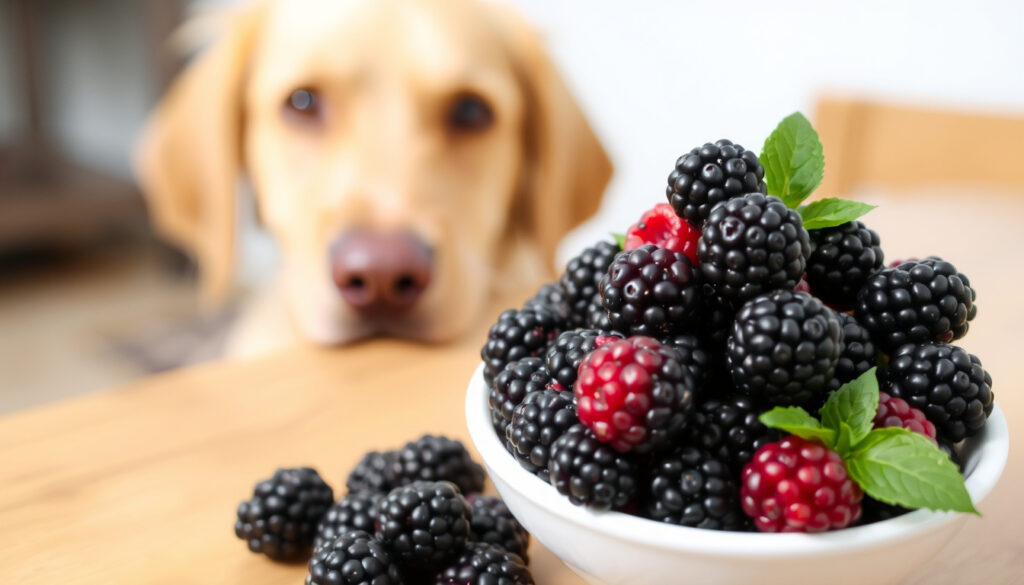
Can Dogs Have Blackberries? Safety, Serving Size, Risks
Anyone who has watched a dog stare down a bowl of glossy blackberries knows the look: pure hope, wrapped in a tiny purple package. The answer to “can dogs have blackberries” is a cautious yes—learn which berries are safe, how many to share without a tummy ache, and why the jam jar on your counter deserves a harder look.
Calories per 100 grams: 43 kcal ·
Fiber per 100 grams: 5.3 g ·
Vitamin C per 100 grams: 21 mg ·
Natural sugar per 100 grams: 4.9 g ·
Treat calorie limit: ≤10% of daily calories
Quick snapshot
- Healthy dogs can generally eat fresh, plain blackberries in moderation (American Kennel Club (canine nutrition guidance)).
- Fresh blackberries do not contain the dangerous added xylitol found in processed foods (American Kennel Club (canine nutrition guidance)). (American Kennel Club (canine nutrition guidance))
- Grapes and raisins are toxic to dogs and can cause kidney failure (Pet Poison Helpline (animal poison control)).
- The exact safe serving size for every dog breed and weight is not standardized in veterinary literature.
- Which individual dogs will have a food sensitivity to berries remains unknown until you introduce them.
- Whether a specific unidentified wild berry is safe requires expert plant identification.
- Xylitol-related hypoglycemia can develop within 10 to 60 minutes after ingestion (Pet Poison Helpline (animal poison control)).
- Signs may begin within 10 to 15 minutes in some cases (Pet Poison Helpline (animal poison control)). (Pet Poison Helpline (animal poison control))
- Suspect any jam, jelly, syrup, or pie filling? Contact your vet or a poison control hotline immediately (Cornell University College of Veterinary Medicine (veterinary medicine research)).
- When in doubt about any berry, ask a vet before offering it. (Cornell University College of Veterinary Medicine (veterinary medicine research))
The numbers above point to a simple pattern: blackberries are a low-calorie treat that bring real fiber and vitamin C. The risk has far less to do with the berry itself than with what gets added to it.
| Key fact | Detail |
|---|---|
| Botanical family | Rosaceae |
| Toxicity to dogs | Non-toxic when fresh and plain |
| Best form | Washed, unsweetened, fresh or frozen |
| High-risk form | Jam, jelly, syrup, or pie filling |
| Calories per 100 grams | 43 kcal |
| Fiber per 100 grams | 5.3 g |
| Vitamin C per 100 grams | 21 mg |
| Natural sugar per 100 grams | 4.9 g |
| Xylitol risk | High in sugar-free processed products (Pet Poison Helpline (animal poison control)) |
| Serving rule of thumb | Keep treats below 10% of daily calories |
One row deserves your attention before the rest: the difference between “fresh” and “processed.” That contrast runs through every safe and risky scenario below.
What berries are ok for dogs?
Raspberries, strawberries, and blueberries are safe too
- Blueberries, raspberries, and strawberries are also safe for dogs in small servings (American Kennel Club (canine nutrition guidance)).
- Plain fresh blackberries are safe for most dogs when served in moderation.
Think of the berry family as a group of friends: they are all welcome at the bowl, but none of them should ever crowd out real meals. The safest berry is one that is plain, washed, and served as a snack, not as a substitute for a meal.
Portion size for dog treats
Portions vary widely with a dog’s size. A commonly published guide uses weight classes as a starting point (Chewy (pet care education)):
- Extra-small dogs (2–20 pounds): 1–2 blackberries
- Small dogs (21–30 pounds): 2–3 blackberries
- Medium dogs (31–50 pounds): 3–5 blackberries
- Large dogs (51–90 pounds): 5–6 blackberries
- Extra-large dogs (91+ pounds): a small handful
Portion charts are a conservative starting point, not a veterinary prescription. Too many blackberries may cause vomiting, diarrhea, gas, or other digestive upset because of the fiber, sugar, or an individual reaction (American Kennel Club (canine nutrition guidance)).
How to offer berries to dogs
Preparation matters more than the berry itself. Always wash berries, remove stems and leaves, and cut large berries into bite-size pieces (American Kennel Club (canine nutrition guidance)). You can serve them whole, diced, mashed, or pureed depending on your dog’s size and preference.
One rule of thumb gives you room to play: treats should make up no more than 10 percent of a dog’s daily calories. If your dog is the kind that vacuums the floor after every meal, that limit keeps blackberries a reward rather than a diet overhaul.
Can dogs have blackberry jam?
Why added sugar and xylitol are a problem
- Blackberry jam often contains added sugar, which can lead to weight gain and dental issues in dogs.
- Some sugar-free jams contain xylitol, a sweetener that is highly toxic to dogs (Pet Poison Helpline (animal poison control)).
- Added xylitol in sugar-free foods is a substantially greater poisoning concern than the trace amount naturally present in blackberries.
Here is the trap that catches many well-meaning owners. Fresh blackberries contain trace amounts of naturally occurring xylitol, but those traces are unlikely to poison a dog in ordinary small servings (American Kennel Club (canine nutrition guidance)). The danger lives in the added xylitol used as a sweetener in sugar-free products, which is a fundamentally different scale of exposure.
Symptoms of xylitol ingestion
Xylitol can cause a rapid drop in blood sugar, vomiting, weakness, and seizures. In severe cases, the consequences escalate quickly:
- Life-threatening hypoglycemia (Pet Poison Helpline (animal poison control))
- Weakness, loss of coordination, seizures, unconsciousness, or collapse
- Acute liver failure in high-exposure cases (Pet Poison Helpline (animal poison control))
Timing matters. Xylitol-related hypoglycemia can develop within 10 to 60 minutes after ingestion, and signs may begin within 10 to 15 minutes in some cases (Pet Poison Helpline (animal poison control)).
Safe ways to give blackberry flavor
Do not feed blackberry jam, jelly, syrup, or pie filling. Instead, use plain mashed or frozen blackberries. If you are making a treat at home, blend fresh berries into a puree with no added sugar and freeze it in small portions, always respecting the 10 percent calorie rule.
For dog owners, the distinction is simple: the fruit itself is fine, but the processed versions are a gamble with your dog’s life. The trade-off is steep, and the safe alternative takes two minutes of prep.
What berries can dogs not eat?
Grapes and raisins are not safe
- Grapes and raisins are toxic to dogs and can cause kidney failure (Pet Poison Helpline (animal poison control)).
- The safe-berry list never includes grapes, even in small amounts.
Grapes are the clearest exception to the “fruit is good” rule. No safe serving size exists, so the only correct portion is zero.
Ornamental and wild berry concerns
Some ornamental berries, including holly and mistletoe berries, are unsafe for dogs. Do not allow dogs to eat unidentified wild berries unless a plant expert confirms they are safe. The backyard looks inviting, but the berry on that shrub is not your grocery-store berry.
Emergency steps after berry ingestion
Contact a veterinarian or pet poison control immediately if a dog eats an unknown berry. If you suspect a product containing xylitol, do not wait for symptoms before calling. The sooner you act, the better the chances of a full recovery.
The pattern across these warnings is consistent: the danger is rarely the familiar fruit, it is the unfamiliar one or the processed one. Knowing the difference keeps treat time simple.
Upsides and downsides of feeding blackberries
Upsides
- Low calorie count at 43 kcal per 100 grams
- Real fiber content at 5.3 g per 100 grams
- Vitamin C at 21 mg per 100 grams
- Naturally sweet, which makes them a good training reward
Downsides
- Fiber and sugar can trigger vomiting, diarrhea, or gas in sensitive dogs (American Kennel Club (canine nutrition guidance))
- Processed blackberry products carry the xylitol poisoning risk
- Portion control requires a little attention from the owner
The implication: plain blackberries offer real benefits but require careful portion control and awareness of processed risks.
How to safely feed blackberries to your dog
- Wash the berries. Rinse them thoroughly under clean water to remove dirt and pesticides (American Kennel Club (canine nutrition guidance)).
- Check the ingredients. Only use fresh or frozen berries with no added sugar, sweeteners, or syrups.
- Prep for the size. Leave whole berries for large dogs, slice them for small dogs, or mash them as a taste test.
- Start with one berry. Watch your dog for 24 hours to see how their stomach reacts.
- Count the calories. Keep all treats within 10 percent of daily calories, which means adjusting meal portions when needed.
- Stop at any sign of trouble. If vomiting, diarrhea, or lethargy appears, stop feeding berries and check with your vet.
What this means: following these steps minimizes the chance of digestive upset or accidental poisoning.
What we know and what we don’t
Confirmed facts
- Fresh, plain blackberries are safe for most dogs when fed in moderation. (American Kennel Club)
- Fresh blackberries do not contain added xylitol. (American Kennel Club)
- Blackberry jam may contain xylitol, which is toxic to dogs. (Pet Poison Helpline)
- Grapes and raisins are toxic to dogs. (Pet Poison Helpline)
What remains unclear
- The exact safe serving size for every dog breed and weight is not standardized in veterinary literature.
- Which individual dogs will have a food sensitivity to berries is impossible to predict until you try.
- Whether a specific unidentified wild berry is safe requires expert plant identification.
The person holding the berry is the real safety filter. A careful owner who reads labels and controls portions gets all the benefit with almost none of the risk.
The catch: the owner’s vigilance is the most critical factor.
What veterinarians and poison experts say
“Healthy dogs can generally eat fresh, plain blackberries in moderation. The key is to offer them as a small part of a balanced diet and watch how your dog responds.”
Small-animal veterinarian
“Added xylitol in sugar-free foods is not a trace concern. It is a poisoning emergency that can cause a rapid drop in blood sugar, seizures, or liver failure.”
ASPCA Animal Poison Control specialist
“Treats, including fruit, should stay within about 10 percent of a dog’s daily calories. That rule keeps a healthy habit from becoming a weight problem.”
Veterinary nutritionist
For dog owners, the message from all three voices is the same: the fruit is fine, the dose matters, and the processed products are the real hazard.
petpoisonhelpline.com, petpoisonhelpline.com, petpoisonhelpline.com
Frequently asked questions
Are blackberries good for dogs?
Yes. Fresh, plain blackberries are low in calories and provide fiber and vitamin C when served in moderation.
Do fresh blackberries contain xylitol?
Fresh blackberries contain only trace amounts of naturally occurring xylitol. Those traces are unlikely to poison a dog in an ordinary small serving (American Kennel Club (canine nutrition guidance)).
Can dogs eat blackberry pie filling?
No. Pie filling typically contains added sugar and may contain xylitol, making it a higher-risk choice than plain fruit (Pet Poison Helpline (animal poison control)).
Should blackberries be cooked before feeding to dogs?
Cooking is not necessary. Washing fresh berries and cutting them to size is enough for most dogs.
Can dogs eat wild blackberries?
Only if you are sure the plant is a true blackberry and the area is free of pesticides. Unidentified wild berries need expert confirmation first.
Are organic blackberries safer for dogs?
Organic blackberries reduce pesticide exposure, but the same rules still apply: wash them, serve plain fruit, and keep portions small.
For dog owners, the decision is now straightforward: keep plain blackberries in the treat rotation for their fiber and low calories, but leave the jam at the table. The one thing standing between your dog and a dangerous dose of xylitol is often just a label you read before you share.
Related reading
More related posts
 Minneapolis Air Quality Warning Memorial Day: What to Know
 Pebble Beach Pro-Am – 2025 Dates Winners Tickets Guide
 How Much Do Veneers Cost? Pricing Guide for Ireland
 Dining Table Set for 6: Size, Material & Price Guide
 Ford Explorer for Sale – Prices, Inventory Near Boston
 What Caused the Great Depression? Major Causes & Lasting Impact
 40 kg to lbs: Exact Conversion and Weight Context
 55 kg to lbs – Exact Conversion to 121.25 Pounds
