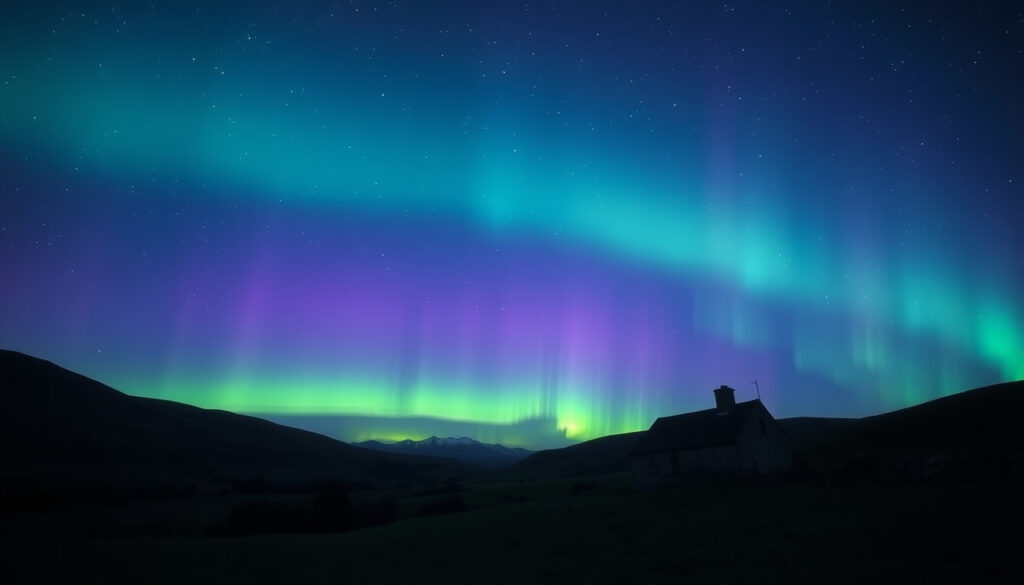
Northern Lights Aurora Borealis Forecast: Tonight in Ireland
If you’ve ever looked up at an Irish winter sky and wondered if that faint green glow might just be the Northern Lights, you’re not alone. The aurora borealis captures the imagination, but catching it in Ireland requires more than luck—it takes the right forecast, a clear horizon, and a bit of timing.
Aurora strength scale (Kp-index) range: 0–9, with Kp 4+ visible in Ireland ·
Best visibility months in Ireland: September to March ·
Optimal viewing time (local) per night: 10 p.m. to 2 a.m. ·
NOAA 30-minute forecast update frequency: Every 30 minutes
Quick snapshot
- Target Kp 4 or higher (NOAA Space Weather Prediction Center)
- Use NOAA 30-minute forecast (NOAA SWPC)
- Bookmark SWPC aurora page (NOAA Aurora Dashboard)
- Clear sky is essential (The Irish Road Trip travel guide)
- Use Met Éireann cloud forecast (The Irish Road Trip)
- Avoid coastal fog zones (The Irish Road Trip travel guide)
- Aim for north-facing coast (Irish Astronomical Association astronomy group)
- Avoid streetlights and towns (Soft Serve News community forecast tool)
- Check light pollution map (Irish Astronomical Association astronomy group)
- Prime window 10 p.m.–2 a.m.
- Longer nights in winter help
- Go out multiple nights
Five key figures you need to know before heading out:
| Parameter | Value |
|---|---|
| Minimum Kp-index for Ireland | 4 (on a scale of 0–9) |
| Average geomagnetic storms per year (Kp 4+) | About 100–150 globally |
| Best months in Ireland | September to March |
| Peak nightly window | 10 p.m. – 2 a.m. local time |
| Official forecast source | NOAA Space Weather Prediction Center |
| Forecast lead time | 30–90 minutes (solar wind travel from L1 point) |
Will the Northern Lights be visible in Ireland?
Ireland sits at a latitude where the aurora is possible but not guaranteed. The key geomagnetic threshold is a Kp-index of 4 or higher, though the Irish Astronomical Association astronomy education group notes that a favourable southerly Bz component can produce displays even at Kp 3. Clear skies are just as critical—cloud cover blocks the show regardless of solar activity.
What Kp-index is needed for Ireland?
- Kp 4 is the standard minimum for Irish latitudes (NOAA SWPC)
- Kp 5–6 increases odds but is not always required (Irish Astronomical Association)
- Bz (north–south orientation) matters more than Kp alone
How does cloud cover affect visibility?
- Cloud cover can block aurora even with perfect geomagnetic conditions
- Met Éireann’s local forecasts are the best Irish tool for cloud predictions
- Coastal fog zones in Donegal and Mayo reduce viewing windows (The Irish Road Trip travel guide)
The implication: A Kp-5 storm is useless if Donegal is under cloud. The trade-off is between driving inland for clear skies and staying on the coast for the aurora—north-facing beaches with clear local windows are the sweet spot.
What time tonight is best to see the Northern Lights?
The standard golden window for aurora viewing in Ireland is 10 p.m. to 2 a.m. local time, with peak activity often around midnight. But the real answer depends on two tools: the NOAA 30-minute forecast and your local darkness.
How to use the NOAA 30-minute forecast
- Bookmark the NOAA Aurora 30-Minute Forecast (based on the OVATION Prime model)
- Forecast lead time is the solar wind travel from the L1 observation point (NOAA SWPC)
- Check the NOAA Aurora Dashboard for combined view
- Refresh every 30 minutes; predictions shift with solar wind changes
Why 10 p.m. to 2 a.m. is the peak window
- Darkness is deepest after astronomical twilight ends (around 10 p.m. in winter)
- Geomagnetic disturbances often intensify around local midnight
- Moon phase matters—a new moon or crescent gives much better contrast (Soft Serve News community forecast tool)
Exact event timing is impossible beyond 30–90 minutes. Don’t set your watch by a 2 a.m. fixed start—check the forecast at 9 p.m., then again at 10 p.m., and be ready to move.
Where is the best place in Ireland to see the Northern Lights?
The short answer: north-facing coasts away from light pollution. The Irish Astronomical Association astronomy education group points to the North Coast and Antrim Coast Road as prime spots, while The Irish Road Trip travel guide highlights Donegal, Malin Head, and the Inishowen Peninsula.
Top spots in Donegal
- Malin Head (Ireland’s northernmost point, minimal light pollution)
- Inishowen Peninsula (multiple north-facing coves)
- Bloody Foreland (west-facing but north component, dark skies)
Why north-facing coasts work best
- Aurora appears along the northern horizon in Ireland
- Dark sea horizon avoids ground-level light scatter
- Northern counties (Donegal, Antrim) have a latitude advantage
The pattern: latitude + darkness + clear horizon = repeatable formula. Observers in Dublin or Cork face stronger light pollution and a lower northern horizon, making successful sightings rare without driving north.
How do I look at the northern lights through my phone?
Yes, you can capture the aurora with a modern smartphone—no DSLR required. The trick is to override automatic settings and use manual controls.
Camera settings for night mode
- Turn off flash. Use Night Mode or Pro mode.
- Set focus to infinity (tap to lock focus on a distant star or light).
- Adjust exposure time: 3–10 seconds (longer for fainter displays).
- Set ISO to 800–1600 (lower ISO reduces grain but needs longer exposure).
- Use a tripod or steady surface—phone shake ruins long exposures.
Apps for aurora alerts
- Aurora Alerts Ireland (Facebook group) – real-time crowd-sourced alerts from Irish viewers
- NOAA’s free forecast page (no app needed, mobile-friendly)
- SpaceWeatherLive – predicted Kp indices and middle-latitude forecasts
Phone sensors are good but can’t match a dedicated camera. For dim displays, you’ll see nothing in the viewfinder—point, shoot, and check the screen after 10 seconds. A phone is a discovery tool, not a gallery tool.
What does the Bible say about aurora lights?
The canonical Bible does not directly mention the aurora borealis. Some readers interpret passages about “fiery skies” in Revelation or “pillars of fire” as possible references, but biblical scholars note these are metaphors for divine presence, not astronomical events.
Biblical passages sometimes linked to the aurora
- Revelation 21:23 – “the city has no need of sun or moon to shine on it” (not aurora-specific)
- Psalm 19:1 – “the heavens declare the glory of God” (general wonder)
- No direct mention of green/red sky lights in canonical texts
Scientific explanation separates from theology
Modern science explains the aurora as solar wind particles colliding with Earth’s magnetosphere and exciting oxygen and nitrogen molecules. The NOAA Space Weather Prediction Center U.S. government agency provides the geophysical basis, independent of theological interpretation. The two perspectives—wonder and physics—can coexist without conflict.
Confirmed facts
- The aurora is caused by solar wind particles colliding with Earth’s magnetosphere (NOAA SWPC)
- A Kp-index of 4 or higher is needed for visibility in Ireland (Irish Astronomical Association)
- The best time to look is 10 p.m.–2 a.m. local time
- Bz (southward) can produce aurora even at Kp 3–4 (Irish Astronomical Association)
- Exact timing of a specific aurora event cannot be predicted more than 30–90 minutes in advance (NOAA SWPC)
- Short-term cloud cover predictions can change rapidly
- Biblical connection to aurora is not supported by mainstream theology or science
“The OVATION Prime model provides a 30 to 90 minute forecast of auroral location and intensity.”
— NOAA Space Weather Prediction Center U.S. government agency
“Ireland’s best chance of seeing the Northern Lights is generally on the north and west coasts, where skies are darker and there is less light pollution.”
— The Irish Road Trip travel and outdoor guide
“A favourable southerly Bz can produce an aurora display even when Kp is only 3 or 4.”
— Irish Astronomical Association astronomy education group
The Soft Serve News Aurora Prediction Program community forecast tool adds that light pollution and weather have a greater impact at marginal viewing locations like Ireland. For Irish viewers, the combination of Kp forecast, cloud cover, and moon phase creates a narrow but navigable decision window.
For viewers in Ireland, the choice is clear: check the NOAA forecast at sunset, scan the cloud cover on Met Éireann, and drive north if both look promising. A two-hour stakeout on a Donegal beach—with phone camera ready—might just pay off with a green arc you’ll remember for years.
Related reading: Canyon Lake Water Level: Current, History & 2026 Forecast
For the most accurate update on viewing conditions, check the northern lights forecast tonight from a trusted space weather source.
Frequently asked questions
Can I see the Northern Lights from Dublin?
Rarely. Dublin’s light pollution and southern latitude make sightings possible only during strong geomagnetic storms (Kp 6+). A drive to the north coast increases your odds dramatically.
What does a Kp-index of 4 mean?
Kp 4 means a minor geomagnetic storm. At Ireland’s latitude, it’s the minimum threshold at which aurora can appear on the northern horizon, provided Bz is southward and skies are clear.
Do I need a special camera to photograph the aurora?
No. A modern smartphone with manual controls (long exposure 3–10 seconds, ISO 800–1600) can capture the aurora, especially if it’s bright. A tripod helps.
How long do aurora displays usually last?
Anywhere from 10 minutes to several hours. Bursts around midnight can fade quickly, while active storms may pulse for 2–3 hours.
Is the aurora visible every night in winter?
No. Auroral activity is tied to solar wind, not seasons. Winter offers longer nights, but geomagnetic storms are unpredictable.
Can the aurora be seen from the southern hemisphere?
Yes—the aurora australis (southern lights) mirrors the northern aurora. But this guide covers Ireland’s northern hemisphere locations.
What causes the different colors in the aurora?
Green is from oxygen about 60 miles up; red from higher-altitude oxygen; blue/purple from nitrogen. These are determined by the energy of colliding particles.
More related posts
 Blood Work Near Me: Cost, Walk-In & Vaping Impact in Ireland
 Kristin Davis Movies and TV Shows: Full Filmography
 How to Contact Amazon Customer Service: Phone, Chat, Email
 Best LEGO Sets for Adults 2024 – Top Picks & Guide
 Sam Houston State University: Rankings, Majors & Admissions
 Poker Face Season 2 – Release Date, Cast, Episodes and Updates
 99 Nights in the Forest Deer: Monster Guide
 Point of Care CNA – Duties, Salary, Certification Guide
