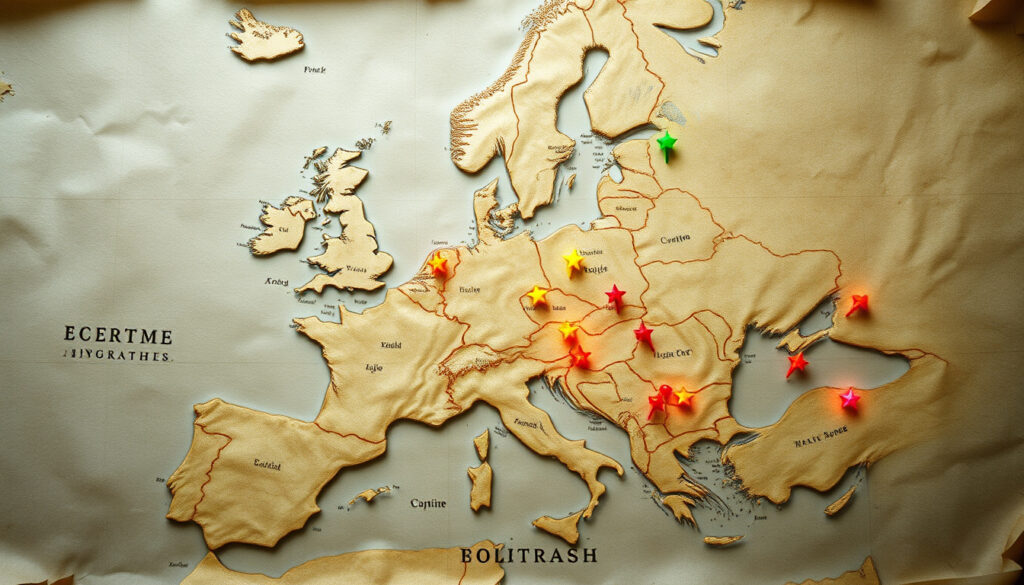
Map of European Countries: Borders, Capitals & Rankings
Europe stretches from the Atlantic to the Ural Mountains, packing 44-to-47 recognized nations into roughly 10 million square kilometers. Most visitors searching for a “map of European countries” expect a clean political outline—but there is much more lurking beneath the surface when you layer on wealth, safety, and livability data. This guide pulls together the borders, capitals, and the cross-referenced rankings that a standard map leaves out.
Total countries: 44-47 depending on definition · EU member states: 27 · Largest country by area: Russia (European part) · Most populous: Germany · Map types common: Political with capitals
Quick snapshot
- EU has 27 members per official site (Eurostat)
- Luxembourg ranked 1st in political stability (index 1.07) in 2024 (TheGlobalEconomy.com)
- Stockholm recorded 55 gunshots, 9 deaths through August 2025 (Euronews)
- Exact country count varies 44-51 by inclusion criteria
- Non-EU rankings (Iceland, Liechtenstein) not fully integrated with EU-focused safety metrics
- Limited 2025-2026 data for wealth beyond 2024 snapshots
- Nordic countries continue to dominate safety and livability indexes
- Eastern European capitals (Vilnius, Prague) showing improved stability post-incidents
- Gun violence trends shifting from Western to Southern European capitals
| Metric | Value |
|---|---|
| Countries (UN member states) | 44 |
| EU Members | 27 |
| Area (million sq km) | 10.18 |
| Population (million) | 746 |
| Density (per sq km) | 73 |
| Wealthiest by GDP per capita PPP | Liechtenstein ($201,112), Luxembourg, Ireland |
| Safest per Global Peace Index 2025 | Iceland, Denmark, Portugal |
| Political stability leader (2024) | Luxembourg (index 1.07) |
How many countries in Europe?
The count depends entirely on which boundaries you recognize. Most authoritative lists settle on 44 UN member states, rising to 47 when you add Vatican City and Monaco—which lack UN membership but are universally acknowledged as sovereign.
Recognized boundaries
Geographers broadly agree on the core continental definition: from Iceland in the west to Russia’s Ural foothills in the east, from Norway’s Arctic reaches to Greece’s Mediterranean shores. What sparks debate are the edges—Turkey spans Europe and Asia, Cyprus sits culturally closer to the Levant, and Russia’s northern territories blur the line further north.
EU vs non-EU
The European Union currently counts 27 member states (Eurostat official data), a number that grew from 6 in 1957 to 27 today after six enlargement waves. Countries like Norway, Switzerland, and Iceland remain outside the EU despite their geographic proximity and economic integration.
Transcontinental inclusions
If you include transcontinental nations, the count stretches further. Turkey (roughly 3% in Europe), Kazakhstan, Azerbaijan, and Georgia each straddle recognized continental boundaries. Most political maps of European countries restrict themselves to the core 44-47 to keep the visualization clean and usable for travel or educational purposes.
The implication: when someone asks “what are the 51 countries in Europe?”, the honest answer is that no single authoritative list exists—the number shifts with the definition.
What are the 10 richest countries in Europe?
Wealth in Europe defies simple geography. Small financial hubs routinely dwarf large industrial nations when measured by per-capita output, creating a ranking that surprises many map-readers.
GDP per capita rankings
Using GDP per capita (PPP) for 2025, Liechtenstein tops the list at $201,112 (World Atlas), followed closely by Luxembourg and Ireland. These three pull far ahead because their small populations amplify the impact of financial services, corporate tax regimes, and multinational headquarters.
Ireland’s position
Ireland ranks fourth in nominal GDP per capita at $99,152 in 2024 (Wikipedia data), and it ranks first on the opportunity index at 82.63 (Wikipedia financial rankings). The country’s wealth rests heavily on corporate tax revenue from multinational tech and pharmaceutical firms—a structural advantage that also makes the figure somewhat brittle.
Wealth metrics
When measuring average household wealth rather than GDP output, Luxembourg leads the EU at €523,591 per adult (Visit Ukraine analysis). Germany, despite its massive total wealth of $14,499 billion, ranks lower per capita due to its large population (Wikipedia rankings). Luxembourg also posted a 4.3% government surplus in 2024, debt held at just 41% of GDP—fiscal headroom most peers cannot match (World Atlas).
Luxembourg and Liechtenstein are rich not because they produce more goods, but because they host more capital. For investors or businesses, that distinction matters: low corporate tax and regulatory openness can outweigh raw market size.
The pattern: Europe’s wealth map does not align with its population map. The richest nations by capita are microstates or small financial centers, not the industrial giants that dominate trade headlines.
What is the safest country in Europe?
Safety in Europe splits dramatically between Nordic exemplars and a handful of capitals dealing with concentrated gun violence. The Global Peace Index 2025 places Iceland at the very top—a position it has held for more than a decade.
Crime index data
Iceland scores highest due to its tiny population (under 400,000), near-absence of gun culture, and unarmed police force (World Population Review). Denmark follows with extremely low crime rates, particularly in Copenhagen, where violent incidents are rare even by Scandinavian standards.
Global Peace Index
The 2025 GPI ranking places Iceland, Denmark, and Portugal at the top of the European list (World Population Review). Cyprus scores 1.933, placing it firmly in the “high safety” band. Portugal combines low crime with political stability, making it a consistent performer across multiple safety datasets.
Top safe nations
Looking at EU capitals specifically, the lowest-risk destinations include Berlin, Dublin, Helsinki, Vilnius, Budapest, Warsaw, Bratislava, Luxembourg City, Valletta, and Tallinn (Euronews gun crime analysis). These cities recorded few or no gun incidents in the past two years. Dublin logged one fatal gun incident; Vilnius had one targeted killing with no broader gang activity.
Safety rankings reward smallness and homogeneity. Nations with armed police traditions, porous borders, or active drug markets score lower—not because they are disorderly, but because they carry more background risk. Travelers should weight urban vs. national averages.
The catch: a safe country can contain dangerous neighborhoods, and a generally turbulent region may host perfectly calm cities. The map of European countries shows borders; it does not show the internal risk distribution that matters most to visitors and residents.
Which is the best country to live in Europe?
“Best” depends on what you optimize for. The Nordic countries dominate quality-of-life indexes when the metric includes healthcare access, education quality, work-life balance, and environmental cleanliness. But affordability and career opportunity pull the answer in different directions.
Quality of life indexes
Nordic nations—Denmark, Norway, Finland, and Sweden—consistently rank at the top of UN and OECD quality-of-life surveys. Denmark specifically wins praise for its low crime rates, strong social safety net, and high civic trust (World Population Review). Iceland’s decade-long streak as the world’s safest country reinforces the Nordic edge.
Expensive vs. affordable
The trade-off is cost. Copenhagen, Oslo, and Stockholm rank among Europe’s most expensive cities. Portugal and the Baltic states (Estonia, Latvia, Lithuania) offer lower living costs while still scoring well on safety and political stability. Lithuania ranks third in the 2024 political stability index at 0.94 (TheGlobalEconomy.com), alongside Czechia at second place.
Work-life balance
Eurostat’s quality-of-life indicators confirm that Nordic countries lead in economic security and physical safety (Eurostat official data). Ireland scores highest on opportunity (82.63), driven by its open economy and English-speaking workforce, but housing costs in Dublin increasingly erode that advantage.
High livability usually means high cost. For remote workers or retirees, Portugal, Estonia, or Lithuania offer a practical middle ground: safer than Southern Europe, cheaper than the Nordics, and fully integrated into the EU for visa purposes.
What this means: the “best” country to live in depends on your stage of life. Young professionals may prioritize opportunity (Ireland). Families may prioritize safety and education (Denmark). Retirees may prioritize cost and healthcare access (Portugal, Lithuania).
What are the 10 most dangerous European countries?
Danger in Europe concentrates in specific capitals rather than spreading across entire nations. Drug-related gang violence drives most of the headline figures, with Brussels, Marseille, and Stockholm producing the most alarming statistics in 2024-2025.
Highest crime rates
Brussels holds the distinction of Europe’s gun crime capital in 2025, driven by escalated drug-related gang violence concentrated in Anderlecht and Molenbeek (Euronews analysis). Stockholm recorded 55 gunshots through August 2025 alone, with nine deaths, attributed to drug gangs recruiting teenage hitmen (Euronews).
Safety concerns
Marseille had 24 shooting deaths in 2024—a figure that represents real improvement from 49 the prior year, though still alarming (Euronews). Paris recorded 34 homicides in 2024 amid at least four deadly gun attacks, suggesting a structural rise in urban violence rather than a temporary spike.
Travel advisories
France’s political stability index stands at -0.24 in 2024, the lowest in the EU (TheGlobalEconomy.com). The EU average across 27 countries sits at 0.5, meaning France is an outlier on the negative side. Lisbon experienced a triple-murder execution-style shooting in 2024, and Rome logged eight shootings with at least five deaths over two years, many mafia-linked.
Riga saw a triple gun murder in 2024; Latvia overall recorded 67 homicides with eight firearm-related deaths. Prague’s mass shooting at Charles University in December 2023 killed 14 people—a single catastrophic event that skews perception even though the capital is otherwise calm. Travelers should monitor active travel advisories rather than relying on static safety rankings.
| Country | GDP per Capita PPP 2025 | Political Stability Rank 2024 | Safety Profile |
|---|---|---|---|
| Luxembourg | $152,394+ | 1st (index 1.07) | Safe capital; 4.3% surplus |
| Ireland | ~Top 3 | High | Dublin: 1 fatal incident |
| Liechtenstein | $201,112 | High | Safe microstate |
| Denmark | High | Very high | Lowest crime in Europe |
| Iceland | High | Very high | Safest globally 10+ years |
| Czechia | Moderate | 2nd (index 0.97) | Safe; post-tragedy recovery |
| France | High total | -0.24 (lowest EU) | Paris: 34 homicides (2024) |
| Belgium | Moderate | Low | Brussels: gun crime capital |
Upsides
- 27 EU members provide freedom of movement and shared standards
- Nordic countries dominate safety, quality of life, and stability rankings
- Eastern European capitals (Vilnius, Prague) offer improving safety with lower costs
- Luxembourg, Liechtenstein, Ireland deliver top-tier wealth per capita
- Marseille showed measurable improvement (49 → 24 shooting deaths)
Downsides
- Country count ambiguity (44-51) confuses maps and travel planning
- Gun violence concentrates in specific capitals regardless of national ranking
- France’s political stability ranks lowest in the EU at -0.24
- Small microstates skew per-capita wealth data, masking inequality
- Non-EU countries like Iceland and Liechtenstein partially excluded from EU-focused rankings
Quotes
Brussels is the most dangerous European capital this year when it comes to gun violence.
— Euronews (European gun crime analysis)
Iceland has ranked as the safest country worldwide for more than 10 consecutive years.
— World Population Review (Safest countries in Europe)
Luxembourg’s blend of a deep financial hub, advanced infrastructure, and skilled, multilingual talent keeps it firmly among Europe’s wealth leaders.
— World Atlas (Richest countries in Europe)
Summary
A political map of European countries shows borders and capitals, but the more actionable layers are the ones you cannot see at a glance: which capitals carry gun violence risk, which countries lead in stability versus wealth, and how those metrics interact. The Nordic trio—Iceland, Denmark, and Norway—sets the safety benchmark. Luxembourg and Liechtenstein define the wealth frontier. France and Belgium sit on the unstable end of the 2024 political stability index, a reality reflected in their capitals’ crime figures. For travelers or investors using this map, the takeaway is simple: borders are fixed, but risk and opportunity move. Layering safety and wealth data onto a standard political map reveals patterns that a clean outline alone would hide.
Related reading: Ax Throwing Near Me: Ireland Venues · The Bad Guys 2 Showtimes: Ireland Cinemas
This detailed borders and capitals overview pairs naturally with the labeled printable Europe map for interactive and printable explorations of the continent’s nations.
Frequently asked questions
Is Ireland really the most prosperous country in Europe?
Ireland ranks first on the opportunity index (82.63) and sits in the top 3 by GDP per capita PPP, driven significantly by corporate tax revenue from multinationals. However, Liechtenstein and Luxembourg have higher per-capita nominal GDP figures, and Ireland’s wealth figure is somewhat inflated by multinational accounting. Whether it is “most prosperous” depends on which metric you weight most heavily.
Who are the big 3 in Europe?
By population, Germany (83M), France (68M), and the United Kingdom (67M) are Europe’s three most populous nations. By GDP, Germany, the UK, and France lead total output. By wealth per capita, the “big 3” would be Liechtenstein, Luxembourg, and Ireland—entirely different nations that win on a per-head basis.
Is Ireland a rich country in Europe?
Yes, Ireland ranks among Europe’s richest by GDP per capita and dominates the opportunity index. The caveat is that much of this wealth flows through foreign multinationals rather than domestic industries, meaning income distribution and cost of living in Dublin partly offset the headline figure.
What is the best country to visit in Europe?
This depends on priorities. For safety, Iceland and Denmark are the strongest choices. For cultural density and history, France, Italy, and Spain remain unparalleled. For value, Portugal, the Baltic states, and parts of Eastern Europe stretch your budget further without sacrificing safety.
Which is the cheapest country to visit in Europe?
Bulgaria, Romania, Hungary, and Albania offer the lowest costs for food, accommodation, and transport. However, safety and infrastructure vary. Within the EU, Estonia and Poland provide a good middle ground—affordable with solid travel infrastructure and EU legal protections.
What are the 51 countries in Europe?
There is no standard list of 51 European countries. The most common counts are 44 (UN member states) or 47 (adding Vatican City and Monaco). Some counts include partially recognized states or transcontinental nations, which can push the total higher, but no major cartographic authority uses the figure 51 as a definitive count.
Are there 44 or 47 countries in Europe?
Both figures are defensible. 44 represents UN member states with territory in Europe. 47 adds three widely recognized sovereign microstates (Vatican City, Monaco, and San Marino) that are not UN members. The choice depends on whether you are using a political, cartographic, or legal definition.
More related posts
 Dancing with the Stars 2025 Cast: US & Irish Stars, Partners
 Last Minute Halloween Costumes: 170+ Easy DIY Ideas
 Weightlifting Fairy Kim Bok-joo – Plot, Cast, Where to Watch
 Rascal Does Not Dream of Bunny Girl Senpai: Watch Order & Season 2
 NASA Astronauts Space Station Evacuation – What Really Happened in 2020
 Sam Houston State University: Rankings, Majors & Admissions
 Green Bay Packers vs Chicago Bears Match Player Stats – Wild Card
 Greek Gods and Goddesses: Complete List and Powers
