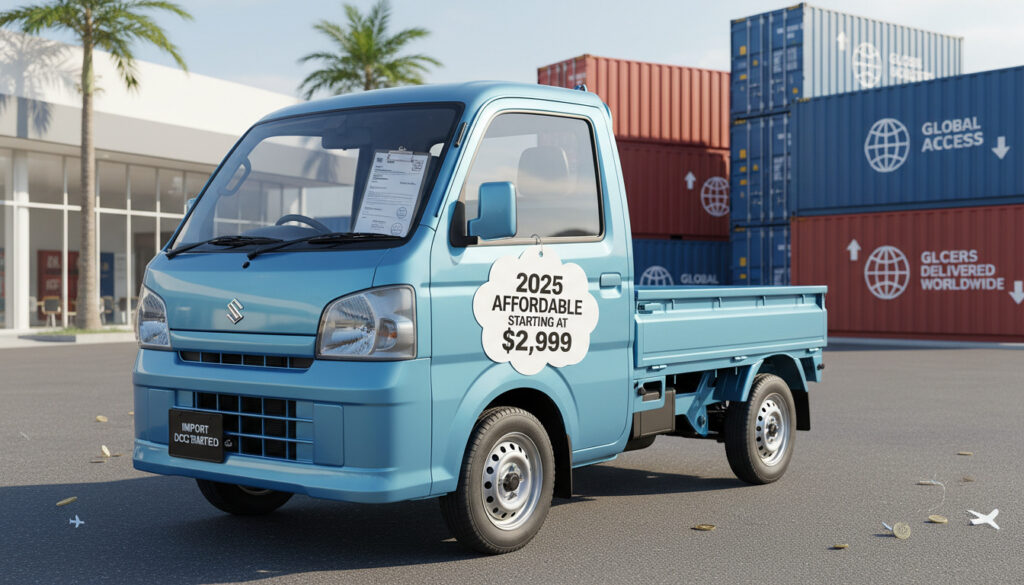
Kei Truck for Sale – 2025 Prices, Legality and Import Guide
Japanese mini trucks are appearing on American farms, job sites, and neighborhood streets with increasing frequency. These compact utility vehicles, known as kei trucks, offer a combination of efficiency and utility that full-size pickups cannot match. As 2025 marks the eligibility of late-1990s and early-2000s fuel-injected models under federal import rules, buyer interest has intensified significantly.
The vehicles originate from Japan’s kei class regulations, which restrict dimensions and engine size to promote economical transportation. American buyers now access these trucks primarily through importers who source inventory from Japanese auctions. Understanding the legal framework, cost structure, and mechanical characteristics proves essential before purchasing.
What Is a Kei Truck?
$5,000–$15,000
Suzuki Carry, Honda Acty, Subaru Sambar, Daihatsu Hijet
25+ year federal exemption; state laws vary
Agricultural work, off-road utility, light delivery
Kei trucks represent a distinct vehicle category defined by Japanese government regulations. The classification mandates maximum dimensions of 3.4 meters in length, 1.48 meters in width, and 2 meters in height. Engine displacement cannot exceed 660cc, and payload capacity typically reaches approximately 350 kilograms.
- 2025 Eligibility Window: Fuel-injected models manufactured in 2000 and 2001 now qualify for import under the 25-year exemption rule.
- Texas Registration: Full street registration became available after April 2024 safety inspection protocols were established.
- Price Variables: Auction prices fluctuate between $5,000 and $15,000 depending on condition, mileage, and import fees.
- Model Dominance: Four manufacturers control the import market: Honda, Subaru, Daihatsu, and Suzuki.
- California Restrictions: The state limits kei truck operation to private property only.
- Age Requirement: Federal law requires vehicles to be 25 years or older to bypass safety and emissions standards.
- Drive Configuration: All models feature right-hand drive, requiring operator adaptation.
| Specification | Details |
|---|---|
| Engine Size | 660cc maximum |
| Maximum Length | 3.4 meters (11.2 feet) |
| Maximum Width | 1.48 meters (4.9 feet) |
| Maximum Height | 2.0 meters (6.6 feet) |
| Payload Capacity | Up to 350 kg (770 lbs) |
| Typical Top Speed | Approximately 60 mph |
| Fuel Delivery | Carbureted (pre-1990s) or Fuel-injected (post-1990s) |
| Drive Options | 2WD or 4WD with high/low range |
Are Kei Trucks Street Legal in the US?
Federal regulations permit the importation of vehicles aged 25 years or older without requiring compliance with current NHTSA safety standards or EPA emissions regulations. This exemption creates the legal pathway for Japanese mini trucks built in 2001 or earlier to enter the United States. However, federal permission does not guarantee state-level registration.
Federal Import Exemptions
The National Highway Traffic Safety Administration maintains the 25-year rule that exempts antique vehicles from Federal Motor Vehicle Safety Standards. Similarly, the Environmental Protection Agency exempts vehicles 21 years or older from emissions compliance requirements. These exemptions allow importers to bring kei trucks into U.S. ports without structural modifications.
Vehicles must reach their 25th anniversary from the manufacture date before importation. A truck built in January 2000 becomes eligible in January 2025. Documentation from Japanese export authorities must verify the production date.
State Registration Variations
Individual states maintain independent authority over vehicle registration and road use. State-specific regulations create a patchwork of permissions across the country.
Texas permits full on-road registration following legislative changes effective April 2024, requiring standard safety inspections. Mississippi allows registration with a $100 title bond. Massachusetts reversed previous restrictions in mid-2024, legalizing street use. Conversely, New Hampshire restricts operation to roads with speed limits of 35 mph or less within a 25-mile radius of the registered address. Louisiana permits use on roads up to 55 mph but prohibits interstate highway access.
California represents the most restrictive environment, classifying kei trucks as off-highway vehicles limited to private property. Prospective buyers should consult their local Department of Motor Vehicles before purchasing, as county-level emissions testing or speed restrictions may apply.
How Much Do Kei Trucks Cost?
Acquisition costs vary based on vehicle condition, model rarity, and import logistics. The market distinguishes between carbureted models from the early 1990s and fuel-injected variants from the late 1990s and early 2000s.
Price Factors and Range
Running examples typically command between $5,000 and $15,000 delivered to U.S. ports. Import fees and shipping costs significantly influence final pricing. Fuel-injected models eligible in 2025 often carry price premiums due to improved reliability and cold-weather starting capability. Four-wheel-drive configurations and low-mileage examples also drive costs higher.
2025 Market Dynamics
Demand has increased markedly as fuel-injected models join the eligible pool. Small business owners and agricultural operators compete with collectors for limited auction inventory. Specialist importers report heightened inquiry volumes for Honda Acty and Suzuki Carry models specifically.
Where to Find Kei Trucks for Sale in the USA
Buyers access the market through two primary channels: direct purchase from U.S. importers who maintain domestic inventory, or commission-based acquisition through Japanese auction houses.
Japanese Auction Sources
Major auction houses in Japan provide the bulk of export inventory. Exporters like Minitrucks.net and Japan Car Direct bid on behalf of American clients, handling Japan-side documentation and port logistics. These services manage shipping arrangements and customs clearance, delivering vehicles to major U.S. ports.
Auction sheets provide condition grades but require translation. Third-party inspection services in Japan can verify mechanical status before bidding. Shipping typically requires 6–8 weeks from port departure to U.S. arrival.
Domestic Dealers and Inventory
Specialized dealers including kei-trucks.com maintain physical inventory within the United States. These retailers handle federal compliance paperwork and often provide state-specific registration assistance. Purchasing from domestic stock eliminates international shipping wait times and allows physical inspection before sale.
Buyers in California must recognize that even federally legal 25-year-old kei trucks cannot receive street registration. These vehicles remain restricted to private property use unless operated under specific agricultural exemptions.
The Honda Acty, Subaru Sambar, Daihatsu Hijet, and Suzuki Carry comprise the majority of available inventory. Fuel-injected variants of these models offer superior reliability for daily use compared to earlier carbureted versions.
Dealers typically provide the necessary export certificates and Japanese deregistration documents required for U.S. titling. Buyers should verify that sellers understand their specific state’s registration requirements.
How to Import a Kei Truck to the US
The importation process follows a specific sequence governed by federal regulations and customs procedures. Understanding this timeline helps buyers set realistic expectations for vehicle arrival.
- State Law Verification: Confirm registration eligibility with your state DMV before committing funds. State restriction databases provide current guidelines.
- Budget Finalization: Account for vehicle cost, shipping (typically $1,500–$3,000), customs fees, and state registration taxes.
- Auction or Dealer Selection: Engage a registered exporter for auction access or select domestic inventory from a U.S. dealer.
- Documentation Preparation: Exporters provide the Japanese Export Certificate, Bill of Lading, and commercial invoice required for customs entry.
- Customs Clearance: Vehicles enter through designated ports where Customs and Border Protection processes the entry.
- EPA and NHTSA Compliance: File EPA Form 3520-1 and NHTSA Form HS-7, marking the vehicle as 25-year-exempt.
- State Registration: Submit customs clearance documents, proof of ownership, and applicable fees to your state motor vehicle authority.
What Is Established Versus What Remains Variable
Confirmed Information
- Vehicles 25 years or older are federally exempt from safety and emissions standards
- Four manufacturers dominate the U.S. import market: Honda, Subaru, Daihatsu, Suzuki
- Fuel-injected models provide better cold-weather reliability than carbureted versions
- Texas, Massachusetts, and Mississippi permit full street registration
- California prohibits on-road use of imported kei trucks
- Right-hand drive configuration is standard on all models
Uncertain or Variable Factors
- Future federal policy regarding new kei truck imports remains undefined
- State regulations continue evolving, with some legislatures considering new restrictions or permissions
- Domestic manufacturing of kei-style vehicles, mentioned in recent federal proclamations, has no confirmed timeline
- Long-term parts availability depends on enthusiast network sustainability
- Insurance classification varies by carrier and state
The Role of Kei Trucks in the American Market
These vehicles occupy a unique position between utility task vehicles and full-size trucks. Their compact dimensions allow access to tight spaces on farms, golf courses, and large estates where standard pickups prove unwieldy. The 660cc engines deliver exceptional fuel efficiency, often exceeding 40 miles per gallon, while the four-wheel-drive capability handles moderate off-road conditions.
The 2025 market expansion reflects broader interest in right-sizing work vehicles. Small business owners appreciate the low operating costs, while collectors value the distinct aesthetic and mechanical simplicity. As domestic automotive manufacturers explore similar compact utility segments, the kei truck import market serves as a proving ground for American acceptance of miniature work vehicles.
Unlike the Other Words for Beautiful – From Pretty to Breathtaking collection of aesthetic terms, these trucks prioritize function over form, yet maintain a utilitarian charm that attracts enthusiasts.
What Industry Sources Report
“Fuel-injected kei trucks from the late 1990s and early 2000s offer significantly better reliability, fuel economy, and easier maintenance than their carbureted predecessors, making them ideal for the U.S. market.”
— Japan Car Direct Technical Analysis, 2025
“States like Texas and Massachusetts have expanded access significantly, while California maintains strict prohibitions. Buyers must verify local DMV requirements before importation.”
— Kei-Trucks.com State Law Database
Essential Points for Prospective Buyers
Purchasing a kei truck requires balancing federal legality against state restrictions, understanding the maintenance requirements of imported vehicles, and budgeting for shipping and documentation fees. The 25-year rule provides clear guidance for eligibility, but local registration authorities maintain final authority over road use. Buyers seeking efficient, compact utility vehicles will find the market offers reliable options, particularly among fuel-injected models from the early 2000s now entering the import stream. For those interested in other specialized imports and detailed guides, consider exploring On the Rocks Cocktails – Meaning, Best Drinks and Tips for a different take on imported specialties.
Common Questions About Kei Truck Purchases
Are kei trucks reliable for daily use?
Yes, particularly fuel-injected models. The 660cc engines are simple and durable, with parts available through U.S. enthusiast networks. Regular maintenance is straightforward due to minimal electronic complexity.
What states allow kei trucks on public roads?
Texas, Massachusetts, and Mississippi permit full registration. New Hampshire and Louisiana allow limited use with speed restrictions. California restricts operation to private property only. Laws change frequently.
How long does the import process take?
From auction purchase to U.S. port arrival typically requires 6–8 weeks. State registration adds additional time depending on documentation processing. Domestic purchases eliminate shipping delays.
Can kei trucks haul heavy loads?
Standard payload capacity is approximately 770 pounds. While sufficient for light farm work and tools, these trucks cannot replace full-size pickups for heavy construction materials or large equipment transport.
Is right-hand drive difficult to operate?
Most drivers adapt within days. The primary challenges involve shifting with the left hand and positioning the vehicle in traffic. The compact size actually improves visibility in tight spaces.
More related posts
 Kelly Oubre Jr.: Stats, Wife, Injury & NBA Career Update
 US Open Men’s Final: Time, Date, Results & Sinner vs Alcaraz
 Map of European Countries: Borders, Capitals & Rankings
 Chicago Style Hot Dog: 7 Toppings, History & Where to Buy
 Sam Houston State University: Rankings, Majors & Admissions
 Chick-fil-A Sauce UK: Buy, Recipe, Aldi Dupe Guide
 Best LEGO Sets for Adults 2024 – Top Picks & Guide
 Card Store Near Me: Find Local Shops, DIY Tips & Card Values
