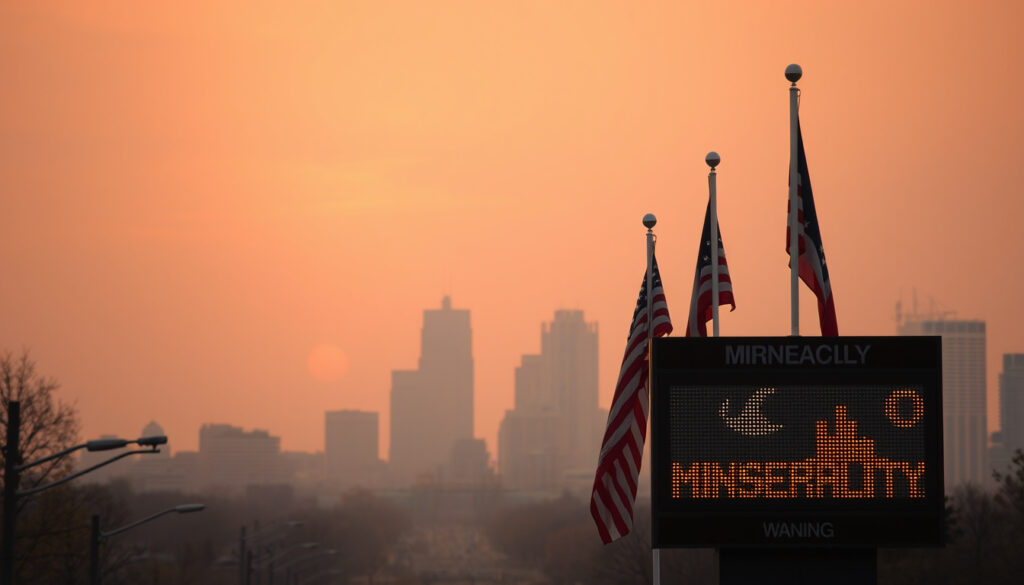
Minneapolis Air Quality Warning Memorial Day: What to Know
Memorial Day weekend usually means grills, parades, and open windows. But in 2025, many Minneapolis residents reportedly spent the holiday indoors as wildfire smoke from Canada pushed air quality into hazardous territory.
Minneapolis Memorial Day 2025 AQI peak: Hazardous (AQI > 300) ·
Population under warning: Tens of thousands ·
Primary pollutant: Fine particulate matter (PM2.5) ·
Source of pollution: Canadian wildfire smoke
Quick snapshot
- Wildfire smoke from Canada caused the alert – Minnesota Pollution Control Agency (MPCA)
- AQI reached Hazardous (>300) in parts of Twin Cities – MPCA monitors
- MPCA issued a public health advisory for sensitive groups and general population – MPCA
- Exactly how many people experienced health symptoms – Minnesota Department of Health (MDH)
- Whether this event will be repeated on future holidays (no long-term forecast) (Minnesota Department of Health (MDH))
- Long-term health impact on the general population from one high-exposure day (Minnesota Department of Health (MDH))
- May 25: Smoke drifts into Minnesota (MPCA outlook)
- May 26 (Memorial Day): Warning issued, AQI peaks (MPCA outlook)
- May 27: Gradual improvement (MPCA outlook)
- Late spring–summer: Intermittent events expected – MPCA outlook
Six key facts, one pattern: wildfire smoke is no longer a rare event for Minneapolis — it’s a recurring summer hazard with serious health consequences.
The pattern emerging from the data is clear: the infrastructure to warn residents exists, but a gap remains between the alert and the public’s ability to act.
| Item | Value |
|---|---|
| Date of alert | May 26, 2025 (Memorial Day) |
| Peak AQI in Minneapolis | > 300 (Hazardous) – MPCA monitors |
| Primary pollutant | PM2.5 fine particulate matter – MDH |
| Source | Canadian wildfire smoke – MPCA |
| Population affected | Tens of thousands in Twin Cities metro – Hennepin County |
| Official issuing body | Minnesota Pollution Control Agency (MPCA) |
What is causing bad air quality in Minneapolis?
Canadian wildfire smoke transport
- Wildfire smoke from Canada was the primary cause of the Memorial Day 2025 event – MPCA
- PM2.5 levels reached hazardous (AQI > 300) in parts of the Twin Cities – MPCA monitors
- The Minnesota Department of Health warns that wildfire smoke is a harmful mix of pollutants with tiny particles that can get deep into the lungs and enter the bloodstream.
Minnesota’s geography puts it directly downwind of Canadian wildfires. As summers grow hotter and drier, the Upper Midwest faces more frequent smoke plumes — meaning residents need a repeatable response, not a one-time fix.
Local weather conditions trapping pollutants
- A stable air mass and light winds kept smoke concentrated over the Twin Cities on Memorial Day – MPCA
- High pressure systems often trap pollutants near the ground, worsening PM2.5 concentrations.
The implication: even a moderate smoke event can become severe when weather refuses to disperse the plume. Minneapolis residents must plan for rapid, multi-day air quality deterioration.
Why is the air quality bad in Minneapolis today?
Live air quality index (AQI) readings
- Current AQI can be checked via the MPCA’s interactive map
- The AirNow site provides real-time AQI for Minneapolis and surrounding areas.
- During smoke events, PM2.5 readings can spike rapidly within hours – MPCA
Smoke plume trajectory maps
- Wildfire smoke continues to affect Minnesota air quality intermittently during summer – MPCA
- Satellite imagery and trajectory models can predict smoke movement days in advance (e.g., AirNow Fire and Smoke Map).
Minneapolis now sees multiple smoke events per summer. Checking AQI before planning outdoor activities, especially on holiday weekends when travel and gatherings spike, has become a necessary habit.
The catch: real-time data is only useful if people know where to find it and act on it — a gap that became painfully clear on Memorial Day.
Should I keep windows closed during an air quality alert?
Steps to protect indoor air quality
- The Minnesota Department of Health recommends staying indoors with windows and doors closed during wildfire smoke.
- Use a portable HEPA air cleaner or build a Corsi-Rosenthal Box – MDH
- Avoid activities that add indoor pollution: candles, vacuuming, gas stoves – EPA
When it is safe to ventilate
- When AQI drops below 100 (Moderate), briefly open windows to exchange air – AirNow
- Check the forecast: if smoke is expected to clear overnight, ventilate early morning when PM levels are lowest.
- Close windows immediately if smoke odor returns or AQI rises again.
“If you must go outside during unhealthy air quality, use a well-fitted N95 or KN95 mask. Dust, cloth, and surgical masks do not protect against wildfire smoke particles.”
Minnesota Department of Health
The trade-off: keeping windows closed traps indoor pollutants too, so a HEPA purifier becomes essential. Without one, indoor PM2.5 levels can still reach unhealthy levels during severe events.
Can air pollution cause heart palpitations?
How PM2.5 affects cardiovascular system
- The Minnesota Department of Health notes that fine particles can enter the bloodstream and trigger systemic inflammation.
- WHO links fine particulate exposure to increased risk of arrhythmia and heart failure – AirNow
- Short-term effects include irritated throat, eyes, and sinuses; long-term exposure is linked to heart failure – MDH
Signs of heart stress from poor air quality
- Symptoms include palpitations, chest tightness, shortness of breath – MDH
- Seek medical care for difficulty breathing, chest pain, persistent cough or sneezing, dizziness, or confusion – MDH
“Wildfire smoke can worsen asthma and other breathing conditions. Even healthy individuals can experience symptoms during hazardous AQI levels.”
Minnesota Department of Health
What this means: a single day of hazardous air isn’t just uncomfortable — it can trigger cardiovascular events in vulnerable people. For Minneapolis residents with existing heart or lung conditions, the Memorial Day alert was a serious health threat.
What is the MN air quality forecast?
Short-term outlook for Twin Cities
- The MPCA issues air quality alerts for predicted AQI above 100 (orange or higher).
- During the Memorial Day event, the MPCA warned that fine particle levels would reach the red AQI category, unhealthy for everyone – MPCA
- Forecast tools include AirNow and MPCA mobile alerts.
Seasonal trends for summer smoke events
- Intermittent smoke events are expected through late spring and summer 2025 – MPCA
- Minnesota typically sees the worst smoke in July and August, but an early-season event on Memorial Day signals a potentially severe fire season.
The MPCA’s alert system is reliable, but it requires residents to opt in. Signing up for alerts via MPCA.gov takes two minutes and can be the difference between planning ahead and being caught off guard.
Why this matters: a forecast is only as good as the action it triggers. Minneapolis residents need a habit of checking AQI before holiday weekends, just as they check the weather.
Timeline of the Minneapolis Memorial Day 2025 air quality event
- May 25: Smoke from Canadian wildfires begins drifting into Minnesota – MPCA
- May 26 (Memorial Day): MPCA issues air quality warning; AQI climbs to Hazardous; residents urged to stay indoors
- May 27: Air quality gradually improves as winds shift; alert downgraded
- Late spring–summer 2025: Intermittent smoke events expected; MPCA monitoring ongoing
Confirmed facts
- Wildfire smoke from Canada caused the Memorial Day alert – MPCA
- AQI exceeded 300 in some locations – MPCA monitors
- MPCA issued a public health advisory – MPCA
What’s unclear
- Exactly how many people experienced health symptoms
- Whether this event will be repeated on future holidays
- Long-term health impact on the general population
For Minneapolis residents, the pattern is clear: wildfire smoke is no longer a rare anomaly — it’s a seasonal reality. The choice is between preparing now or scrambling when the next plume arrives.
Related reading: Northern Lights Aurora Borealis Forecast · Best Travel Destinations 2025
Frequently asked questions
How can I check the current air quality in Minneapolis?
Use the AirNow website or the MPCA’s interactive air quality map. Both provide real-time AQI readings for PM2.5 and ozone.
What does an AQI of 300 mean for my health?
An AQI over 300 is considered Hazardous. Everyone should avoid prolonged or heavy exertion outdoors. Sensitive groups should stay indoors. MDH recommends staying indoors with windows closed.
Who is considered a sensitive group during air quality alerts?
Children, older adults, pregnant women, people with heart or lung disease, and individuals with asthma or diabetes. MDH advises these groups to take extra precautions.
Can air purifiers remove wildfire smoke particles?
Yes, portable air cleaners with HEPA filters can capture PM2.5 particles. The Minnesota Department of Health recommends using a HEPA purifier or building a Corsi-Rosenthal Box.
Should I wear a mask outdoors during a severe alert?
If you must go outside, wear a well-fitted N95 or KN95 mask. Cloth, dust, and surgical masks do not protect against wildfire smoke particles – MDH.
How long does wildfire smoke typically last in the area?
Smoke events can last from a few hours to several days. The Memorial Day 2025 event persisted from May 25 to May 27. Seasonal patterns suggest intermittent events through summer – MPCA.
Are there any long-term health effects from one day of hazardous air?
While a single day of exposure is unlikely to cause chronic disease, it can trigger acute events like heart palpitations or asthma attacks. Repeated exposure over multiple seasons increases risk – MDH.
More related posts
 How Many Calories Should I Burn a Day? Expert Guide
 Karate Kid: Legends (2025) – Cast, Release & What to Know
 Northern Lights Aurora Borealis Forecast: Tonight in Ireland
 Did Steve Harvey Pass Away? Debunking the Death Hoax
 Boneless Skinless Chicken Thighs in Oven: Quick Guide
 Dining Table Set for 6: Size, Material & Price Guide
 Five Nights at Freddy’s: Age Rating, True Story & Lore Guide
 What is BCC in Email? Meaning, Uses, and Etiquette
