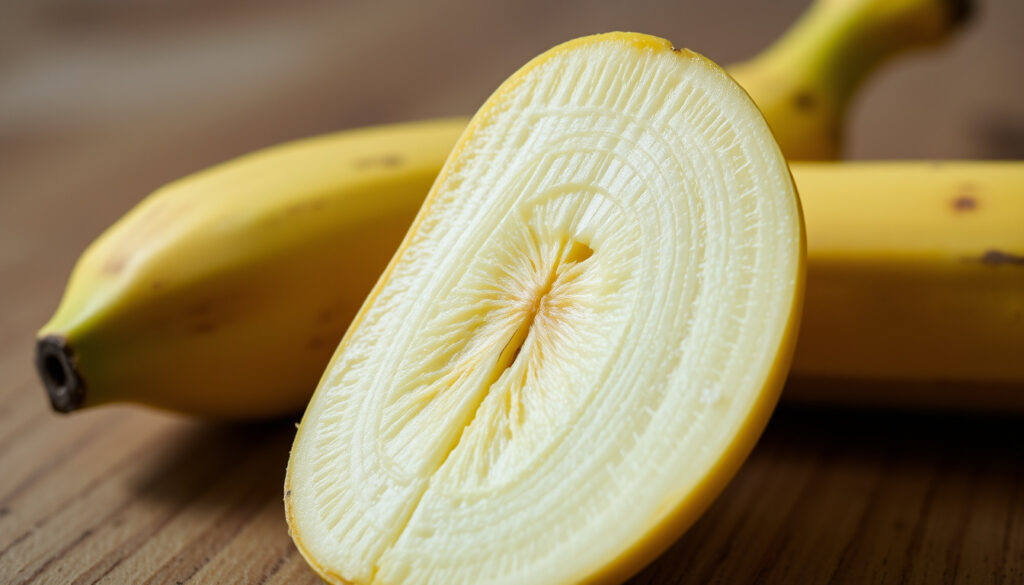
Do Bananas Have Fiber? Nutrition Facts and Benefits
You probably grabbed a banana this morning for a quick, healthy snack, but the answer to whether it delivers on fiber depends on ripeness. We’ll break down exactly what a banana’s fiber content means for your digestion, how it stacks up against other fruits, and when it might help or hinder your bathroom routine.
Fiber in one medium banana: 3 grams ·
Fiber in a green banana: over 3 grams ·
Fiber in an overripe banana: less than 2 grams ·
Daily fiber recommendation (adults): 25–38 grams
Quick snapshot
- Medium banana: 3g fiber (NIH research review)
- Green: over 3g fiber (EatingWell)
- Overripe: less than 2g fiber (EatingWell)
- Contains pectin (soluble fiber) (Medical News Today)
- Ripe bananas may relieve constipation (Baptist Health)
- Green bananas can be constipating (Health)
- Soluble fiber feeds gut bacteria (Baptist Health)
- Apple with skin: 4.4g (NIH)
- Raspberries: 8g per cup (NIH)
- Pear: 5.5g (NIH)
- Banana is a moderate source (Verywell Health)
- 2 bananas = 6g fiber (NIH)
- Total daily need: 25-38g (NIH)
- Combine with other high-fiber foods (Baptist Health)
Here is a quick reference table of banana fiber facts.
| Metric | Value | Source |
|---|---|---|
| Fiber per medium banana | 3 grams | NIH |
| Fiber in green banana | over 3 grams | EatingWell |
| Fiber in overripe banana | less than 2 grams | EatingWell |
| Daily fiber recommendation (adult) | 25–38 grams | NIH |
| Soluble fiber content | Pectin (increases with ripeness) | Medical News Today |
| Rank among fruits | Moderate; raspberries lead at 8g per cup | NIH |
Are bananas a good source of fiber?
How much fiber is in a banana?
A medium banana (about 120 grams) provides approximately 3 grams of fiber, according to a review published in the NIH National Library of Medicine. That’s roughly 8-12% of the daily recommended intake for adults, which ranges from 25 to 38 grams depending on age and sex.
But that number shifts depending on how yellow — or brown — your banana is. Verywell Health notes that green bananas contain a higher proportion of resistant starch, which functions differently in the gut than the fiber found in fully ripe fruit.
The more you wait for sweetness, the less total fiber you get. A fully green banana packs over 3 grams, while a spotted, overripe banana drops below 2 grams.
Does the ripeness of a banana affect its fiber content?
Yes — and the change is more than just a gram or two. As bananas ripen, their starches convert to sugars, and the type of fiber shifts. Medical News Today explains that resistant starch decreases while soluble pectin increases. The result is a fruit that’s sweeter, softer, and gentler on the digestive system — but with less structural fiber.
- Green banana: over 3g total fiber, high in resistant starch
- Yellow banana: about 3g fiber, balanced between soluble and insoluble
- Overripe banana: under 2g fiber, mostly soluble pectin
The implication: if you’re eating a banana specifically for its fiber content, greener is better. But if you’re aiming for digestive comfort, ripeness may matter more than raw grams.
Are bananas good for your bowels?
Do bananas help with constipation?
Ripe bananas contain soluble fiber, particularly pectin, which absorbs water and softens stool. Baptist Health reports that this type of fiber helps promote regularity — provided you also drink enough water. The Gastroenterology Consultants of Georgia add that the peel color is a reliable ripeness indicator: go for yellow with brown spots if constipation relief is your goal.
Can bananas cause constipation?
Unripe bananas can be constipating for some people. Health explains that green bananas are high in resistant starch and tannins — compounds that slow digestion and can aggravate constipation in sensitive individuals. Prevention notes that while there isn’t strong evidence bananas universally cause constipation, people with sensitive digestive systems may react differently, particularly those with IBS.
Which fruit has the most laxative effect?
Bananas are moderate on the laxative scale. Prunes, figs, and kiwis are far more effective for relieving constipation due to their higher fiber content and natural compounds. According to Health, prunes remain the gold standard, with about 7.7 grams of fiber per 100 grams and sorbitol, a natural sugar alcohol that draws water into the bowel.
If constipation is your problem, a ripe banana is a decent choice. But prunes or kiwi will get you there faster. If you’re prone to loose stools or IBS, stick to fully ripe bananas and avoid green ones entirely.
The choice of banana ripeness can turn a fiber source into a digestive aid or a potential blocker.
Which has more fiber, an apple or a banana?
How does banana fiber compare to other fruits?
A medium apple with skin contains about 4.4 grams of fiber — roughly 46% more than a banana’s 3 grams. But the comparison isn’t just about total fiber; it’s about fiber type. Bananas contain a notable amount of soluble pectin, while apples offer a mix of soluble pectin and insoluble cellulose, particularly in the skin.
Six fruits ranked by fiber content per serving:
| Fruit (medium serving) | Fiber (grams) |
|---|---|
| Raspberries (1 cup) | 8.0 |
| Pear (1 medium) | 5.5 |
| Apple with skin (1 medium) | 4.4 |
| Banana (1 medium) | 3.0 |
| Orange (1 medium) | 3.1 |
| Strawberries (1 cup) | 3.0 |
What fruit is the highest in fiber?
Raspberries lead the fruit category with about 8 grams of fiber per cup, according to data from the NIH review. Pears, apples, and bananas follow, with bananas sitting comfortably in the moderate range. If your goal is to maximize fiber intake at breakfast, berries offer more per volume — but bananas win for convenience and portability.
What fruit is the highest in fiber?
What are 5 high-fiber foods?
Fiber comes from many sources beyond fruit. Here are five standouts based on data compiled by the NIH:
- Raspberries — 8g per cup
- Pear — 5.5g per medium fruit
- Apple with skin — 4.4g per medium fruit
- Banana — 3g per medium fruit
- Broccoli — 5g per cup, cooked
What is the best fiber for your bowels?
The best fiber for bowel regularity is soluble fiber, which dissolves in water and forms a gel-like substance that softens stool. Bananas are a solid source of soluble pectin, especially when ripe. Baptist Health notes that soluble fiber also feeds beneficial gut bacteria. For bulk — the kind that moves stool through the colon — insoluble fiber from whole grains and vegetables is equally important. A mix of both types yields the best results.
Is 2 bananas a day too much fiber?
How many bananas should you eat in a day?
Two bananas provide about 6 grams of fiber — well within the daily recommendation of 25 to 38 grams, as confirmed by NIH dietary guidelines. For most people, eating two bananas a day is not too much fiber. In fact, it’s a reasonable contribution toward the total daily target.
What is the daily recommended fiber intake?
The NIH recommends 25 grams per day for adult women and 38 grams per day for adult men. Most Americans fall short, averaging only about 15 grams daily. Adding two bananas adds 6 grams — a meaningful 16-24% boost depending on your target.
For most people, two bananas a day is a safe and convenient way to boost fiber intake without exceeding recommendations.
Confirmed facts and what remains unclear
Confirmed facts
- Bananas contain about 3g fiber per medium fruit (NIH)
- Daily fiber recommendation is 25-38g for adults (NIH)
What’s unclear
- Exact fiber content varies by banana size and variety
- Individual response to banana fiber may differ based on gut health and IBS status
- Ripeness affects fiber quantity and type, but the exact shift per stage is not fully standardized (Medical News Today)
- Green bananas may cause constipation in sensitive individuals, but evidence is not universal (Health)
- Ripe bananas can help relieve constipation, but effectiveness varies with hydration and individual gut health (Baptist Health)
Expert perspectives on banana fiber and digestion
A one-half cup serving of ripe banana (120 g) provides 3 grams of total dietary fiber, mostly soluble fiber.
— NIH National Library of Medicine (Constipation Diet Review)
A fully green banana contains more than 3 grams of fiber, while an overripe banana possesses less than 2 grams.
— EatingWell, citing registered dietitian insights (Ripeness and Fiber)
Unripe bananas may cause constipation, while ripe bananas can help relieve constipation.
— Baptist Health (Gastroenterology Blog)
Final take
For anyone who reaches for a banana as a quick fiber source, the ripeness rule is simple: green means more total fiber but potential bloating, yellow means moderate fiber and gentle digestion. Two bananas a day can comfortably contribute toward your daily fiber target without overdoing it. For the person trying to improve bowel regularity, the choice is clear: eat ripe bananas, drink water alongside them, and pair them with higher-fiber fruits like berries or pears when you want a bigger push.
mool.health, wellandgood.com, doctorguideonline.com, truemeds.in, credihealth.com
Frequently asked questions
Do bananas have more fiber when cooked?
Cooking bananas — such as boiling or baking — does not significantly increase fiber content. However, cooking can break down some resistant starch, making the remaining fiber more available for digestion.
Can eating bananas help with diarrhea?
Yes. Ripe bananas are often recommended for diarrhea because their soluble pectin helps absorb excess water in the gut, while their potassium content replenishes lost electrolytes.
Are banana peels high in fiber?
Banana peels are indeed high in fiber — about 6 grams per medium peel — but they are not commonly eaten raw. They can be boiled, blended into smoothies, or cooked in curries, though taste and texture may be challenging for some.
How does banana fiber compare to oat fiber?
Oats contain 10 grams of fiber per 100 grams, mostly beta-glucan. Bananas provide about 2.6 grams per 100 grams, primarily pectin. Oats are a more concentrated fiber source, but bananas offer additional vitamins and convenience.
What is the glycemic index of bananas?
The glycemic index of a ripe banana is about 51-55, which is considered low to moderate. Green bananas have a lower GI due to their resistant starch content.
Do bananas contain prebiotic fiber?
Yes. The soluble pectin in bananas acts as a prebiotic, feeding beneficial gut bacteria. This is especially true for slightly underripe bananas, which contain more resistant starch that ferments in the colon.
More related posts
 Is Coffee Good for You – Benefits, Risks and Science
 10-Year Treasury Yield Today: What It Is and Why It Matters
 For Whom the Bell Tolls – Summary, Themes and Analysis
 A Como Esta El Dolar – Current Argentina Exchange Rates
 Landman Season 2 Cast: Returning Stars, New Additions, Departures
 Is Hometown Cha-Cha-Cha Worth Watching? A Complete Guide [2024]
 179 cm in Feet – Exact Conversion and Height Guide
