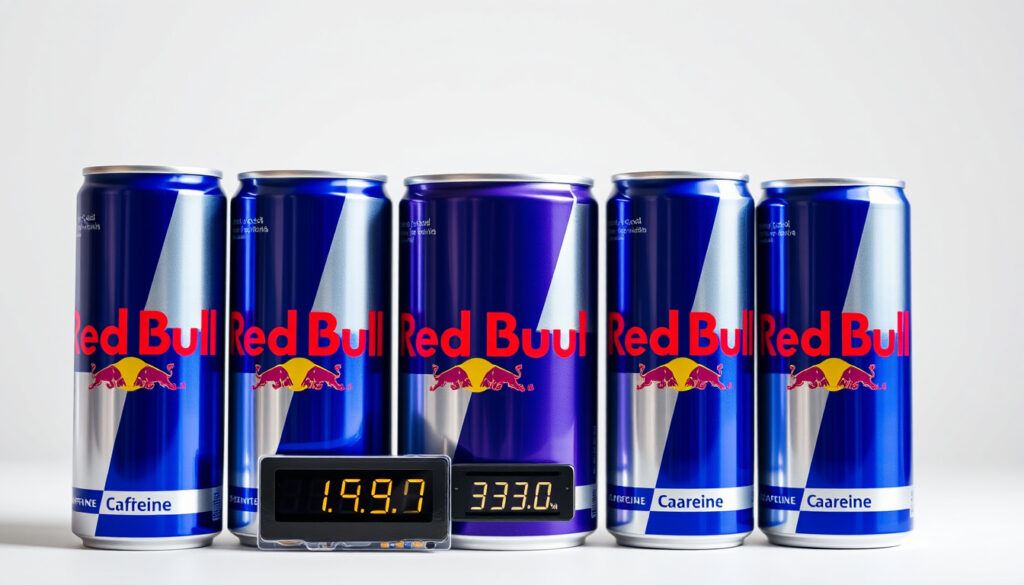
How Much Caffeine Is in a Red Bull? Exact mg by Can Size
A standard 250 ml Red Bull contains 80 mg of caffeine, nearly identical to an 8 oz cup of coffee, but the added sugar and taurine create a different effect on your body. Here’s what the data says about Red Bull’s caffeine content, how it compares to coffee, and what health authorities recommend as safe daily limits.
Caffeine in 250 ml Red Bull: 80 mg · Caffeine in 355 ml Red Bull: 110 mg · FDA Daily Limit: 400 mg · Coffee (8 oz) Caffeine: 80-100 mg · Time to Peak Effect: 30-60 minutes
Quick snapshot
- Red Bull 250 ml contains 80 mg of caffeine (Red Bull official Q&A).
- The FDA recommends a daily caffeine limit of 400 mg for healthy adults (FDA consumer update).
- Caffeine can worsen symptoms of anxiety in susceptible individuals (Mayo Clinic).
- A standard 8 oz cup of coffee contains 80-100 mg of caffeine (Healthline).
- The exact caffeine content of a 500 ml Red Bull can varies by market and formulation (no official 500 ml can widely distributed). (Better Health Victoria)
- The long-term health effects of daily Red Bull consumption are still being studied due to the combination of ingredients. (Better Health Victoria)
- Individual sensitivity to caffeine varies significantly based on genetics and tolerance (Better Health Victoria).
- Ongoing research examines the combined effects of caffeine, taurine, and sugar in energy drinks on cardiovascular health (FDA).
- Regulatory bodies continue to monitor caffeine safety for adolescents and pregnant women (FDA).
- Peak caffeine levels in blood occur 30-60 minutes after consumption (Caffeine Informer).
- Ongoing research examines the combined effects of caffeine, taurine, and sugar in energy drinks on cardiovascular health (FDA).
- Regulatory bodies continue to monitor caffeine safety for adolescents and pregnant women (FDA).
Six key facts about Red Bull’s caffeine content, one pattern: the caffeine concentration is consistent across all standard flavors, but can sizes vary widely across markets.
| Attribute | Value |
|---|---|
| Caffeine in 250 ml Can | 80 mg |
| Caffeine in 355 ml Can | 110 mg |
| Caffeine per 100 ml | 31.98 mg |
| Caffeine in 8 oz Coffee | 80-100 mg |
| FDA Recommended Daily Limit | 400 mg |
| Time to Peak Caffeine Level | 30-60 minutes |
How Much Caffeine Is in a 250 ml Red Bull?
Red Bull Caffeine Content by Can Size
The most commonly asked question gets a straightforward answer: a standard 8.4 fl oz (250 ml) can of Red Bull contains 80 mg of caffeine, according to Red Bull’s official Q&A. That puts it right in the same ballpark as an 8 oz cup of home-brewed coffee, which contains 80-100 mg.
Red Bull’s caffeine concentration is consistent across flavors — including Sugar Free and the Iced Vanilla Berry Edition. The difference is in the can size. Here’s the breakdown:
| Can Size | Caffeine Content | Equivalent Coffee (8 oz) |
|---|---|---|
| 250 ml (8.4 fl oz) | 80 mg | ~1 cup |
| 355 ml (12 fl oz) | 110 mg | ~1.4 cups |
| 473 ml (16 fl oz) | ~151 mg (extrapolated) | ~1.9 cups |
| 500 ml (estimated) | ~160 mg (extrapolated) | ~2 cups |
The pattern: Because Red Bull uses the same caffeine-to-volume ratio across its lineup, a larger can simply means more caffeine linearly. There’s no “extra strength” version — just bigger packages. For someone who buys a 355 ml can, that’s 110 mg — about 27% higher than a standard 8 oz coffee.
How Much Caffeine Is in a 500 ml Red Bull?
There is no widely distributed 500 ml can of Red Bull in most markets, but based on the standard concentration of 31.98 mg per 100 ml (Healthline), a 500 ml serving would contain approximately 160 mg of caffeine. That’s the equivalent of two 8 oz cups of coffee.
Caffeine Per 100 ml
For precise comparison, Red Bull delivers 31.98 mg of caffeine per 100 ml. That’s about the same as a standard cup of coffee per unit volume but less than espresso (which can exceed 200 mg per 100 ml).
The uniformity of Red Bull’s caffeine per volume means you can predict exactly how much you’re getting from any can size. But the real variables are sugar, taurine, and B vitamins — ingredients that coffee lacks and that may affect how the energy boost feels.
How Much Caffeine Is in Red Bull vs Coffee?
Caffeine in a Standard Cup of Coffee
An 8 oz cup of brewed coffee contains between 80 and 100 mg of caffeine, depending on the bean and brewing method (Mayo Clinic). That overlaps almost exactly with a 250 ml Red Bull’s 80 mg.
Red Bull vs Black Coffee: The Differences
Although the caffeine numbers are nearly identical, the body’s response can differ. Red Bull adds 27 g of sugar per 8.4 oz can, along with taurine and B vitamins. Coffee is a natural source of antioxidants and has no added sugar.
| Attribute | Red Bull (250 ml) | Coffee (8 oz, brewed) |
|---|---|---|
| Caffeine | 80 mg | 80-100 mg |
| Sugar | 27 g | 0 g |
| Calories | ~110 | ~2 |
| Key additives | Taurine, B vitamins | Antioxidants (e.g., chlorogenic acid) |
| Peak effect | 30-60 min | 30-60 min |
The trade-off: If you choose Red Bull for the caffeine alone, you’re also getting a significant sugar spike that may cause an energy crash later. Coffee offers a cleaner stimulant with no sugar. For anyone watching their sugar intake, black coffee is the leaner pick.
Red Bull markets its blend of taurine and caffeine as providing “wings,” but the FDA and Mayo Clinic note that the safety of long-term daily use of such combinations hasn’t been studied as extensively as plain coffee.
What this means: When choosing between the two, the caffeine content alone doesn’t tell the full story – the sugar and additives make Red Bull a less neutral option for regular consumption.
Is 200 mg of Caffeine High?
Understanding the FDA Daily Caffeine Limit
The U.S. Food and Drug Administration states that 400 mg per day is an amount not generally associated with negative effects for healthy adults (FDA consumer update). That’s roughly two to three 12 oz cups of coffee, or five standard 250 ml Red Bulls.
What 200 mg of Caffeine Looks Like in Drinks
200 mg is a moderate dose — about 2.5 Red Bulls or 2 cups of coffee. For most adults, that’s well within the safe zone. The European Food Safety Authority also concluded in 2015 that up to 400 mg per day does not raise safety concerns for healthy adults (Red Bull Q&A).
What this means: 200 mg is not high — it’s half the daily limit. A single Red Bull (80 mg) is only 20% of the FDA ceiling. The risk comes from stacking multiple caffeinated drinks throughout the day.
Is 1 Red Bull a Day Ok?
Safety of Daily Red Bull Consumption
One 250 ml Red Bull (80 mg) is well within the FDA’s 400 mg limit. However, daily consumption introduces other factors. The Healthline report notes that regular intake of sugary energy drinks may have negative metabolic effects, including weight gain and insulin resistance, even at safe caffeine levels.
Caffeine and Anxiety: What the Research Says
Research from the Mayo Clinic shows that caffeine can exacerbate anxiety symptoms and trigger panic attacks in sensitive individuals. For those predisposed to anxiety disorders, even 80 mg may be too much.
Upsides and Downsides of Daily Red Bull
Upsides
- Low caffeine dose (80 mg) relative to FDA limit.
- Convenient, portable energy boost.
- Contains B vitamins that aid metabolism.
Downsides
- High sugar content (27 g) can spike blood glucose.
- Acidic drink may erode tooth enamel over time.
- May increase anxiety in sensitive individuals.
The implication: One Red Bull a day is unlikely to be dangerous for a healthy adult, but the sugar and other additives make it a less optimal daily choice than unsweetened coffee or tea. For adolescents, even one can may exceed the recommended 100 mg daily limit (Healthline).
Pregnant and nursing women are advised to limit caffeine to 200 mg per day (Red Bull’s own guidance). One Red Bull is well under that, but combined with other caffeine sources it can add up quickly.
The catch: Even though the caffeine level is safe, the combination of sugar and taurine makes daily Red Bull a less ideal habit compared to plain coffee.
Is 1000 mg of Caffeine a Lot?
Symptoms of Caffeine Overdose
Yes — 1000 mg is more than double the FDA’s 400 mg daily limit. The FDA warns that toxic effects such as seizures can occur with rapid consumption of around 1,200 mg (FDA). Overdose symptoms include heart palpitations, insomnia, nausea, vomiting, and severe anxiety.
What Consuming 1000 mg Looks Like in Practice
Reaching 1000 mg would require drinking 12.5 standard Red Bulls in a day. That’s impractical for most people, but it could happen if you also consume coffee, energy shots, or caffeine pills. A single can of some high-caffeine energy drinks (e.g., 16 oz Monster) contains 160 mg, so stacking several can add up.
Why this matters: For anyone who drinks multiple caffeinated beverages, it’s easy to accidentally exceed safe levels. The FDA’s “spilling the beans” update emphasizes that pure caffeine powder is especially dangerous because a small amount can deliver lethal doses.
What you should do: If you consume multiple energy drinks or coffee throughout the day, track your total caffeine intake to stay below 400 mg.
Clarity Check
Confirmed facts
- Red Bull 250 ml contains 80 mg of caffeine (Red Bull).
- FDA recommends max 400 mg/day for adults (FDA).
- Caffeine can worsen anxiety (Mayo Clinic).
- 8 oz coffee has 80-100 mg caffeine (Healthline).
What’s unclear
- Exact caffeine in 500 ml Red Bull varies by market (no official can).
- Long-term effects of daily Red Bull with taurine/sugar are under study.
- Individual caffeine sensitivity varies genetically.
Expert Perspectives
The caffeine in a standard 250 ml Red Bull (80 mg) is about the same amount as a cup of home-brewed coffee.
Red Bull official Q&A
Up to 400 mg of caffeine a day appears to be safe for most adults.
Mayo Clinic
400 mg per day is about two to three 12-fluid-ounce cups of coffee and is not generally associated with negative effects.
U.S. Food and Drug Administration
For anyone who reaches for a Red Bull to power through an afternoon slump, the numbers show it’s not the caffeine that sets it apart — it’s the added sugars and taurine. Your choice between Red Bull and coffee comes down to metabolic effects, not energy boost. If you’re healthy and limit yourself to one can, Red Bull is fine. But if you’re managing anxiety, watching sugar intake, or pregnant, black coffee is the safer bet. For the average American adult, the decision is clear: use Red Bull as an occasional tool, not a daily habit, or choose coffee for a stimulant without the sugar spike.
caffeineinformer.com, trackcaffeine.com, ethans.com, depts.ttu.edu, egrocery.asia, reddit.com
Frequently Asked Questions
Does Red Bull have more caffeine than Monster Energy?
Per 8.4 oz, Red Bull has 80 mg. Monster Energy’s 16 oz can contains 160 mg, which is 80 mg per 8 oz. They are nearly identical per volume.
How long do the effects of Red Bull caffeine last?
Caffeine’s half-life is about 3-5 hours. The stimulating effects begin within 30-60 minutes and can last 4-6 hours, depending on individual metabolism.
What is the sugar content of a standard Red Bull?
A 250 ml can contains 27 g of sugar (about 6.5 teaspoons). Sugar Free versions use aspartame and acesulfame K.
Can pregnant women safely drink Red Bull?
Red Bull recommends pregnant women limit caffeine to 200 mg per day, which allows for one can. However, the added sugar and other ingredients may be suboptimal; consulting a doctor is advised.
Is it safe for teenagers to drink Red Bull?
Healthline reports that adolescents ages 12-19 should limit caffeine to 100 mg or less per day. A full can of Red Bull (80 mg) is near that limit, so occasional use may be acceptable, but daily consumption is not recommended.
How does the caffeine in Red Bull compare to a can of Coke or Pepsi?
A 12 oz can of Coke contains 34 mg of caffeine, Pepsi has 38 mg. Red Bull has more than double that amount — 80 mg in 8.4 oz.
Does Red Bull contain any nutritional benefits beyond energy?
Red Bull contains B vitamins (B6, B12, niacin, pantothenic acid) that aid energy metabolism, but these are also available from food. The high sugar content offsets any potential benefit.
Related reading
More related posts
 $1,702 Stimulus Payment Date: Alaska Dividend 2025
 Foods That Cause Inflammation: The Top 10 to Avoid
 Is Coffee Good for You – Benefits, Risks and Science
 Kairat vs Real Madrid – Preview, Lineups, Prediction
 Carrie-Anne Moss: Matrix Star Bio, Career Update & Now
 1-888-280-4331 Amazon Customer Service Phone Number (US) 24/7
 College Football Bowl Games 2025-26: Full List & Schedule
 Dining Table Set for 6: Size, Material & Price Guide
