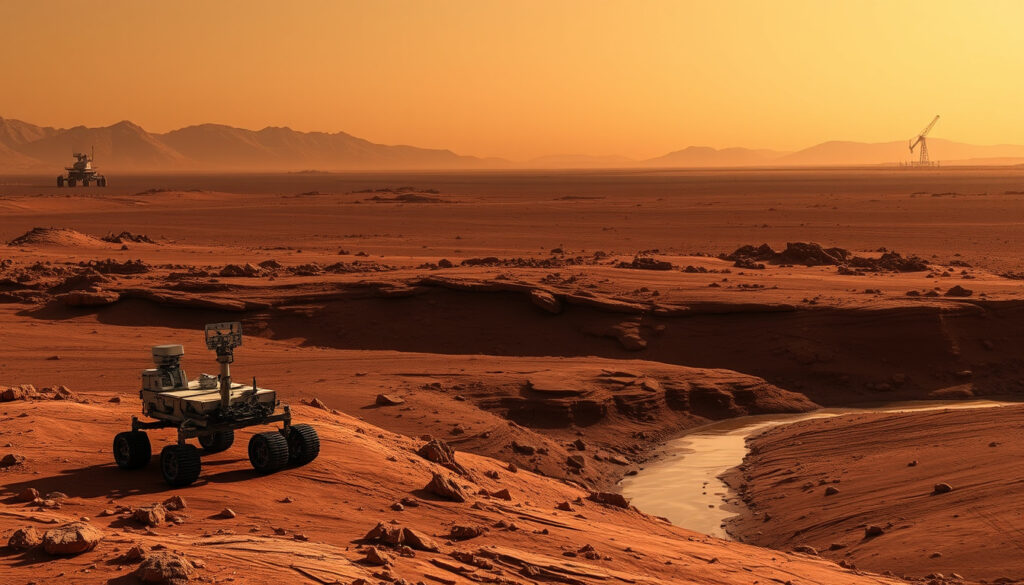
NASA Life on Mars: Evidence, Missions & 2025 Update
For decades, the question has lingered: were we ever neighbors with Martians? NASA’s Perseverance rover may have just brought us closer to an answer. In September 2025, the agency confirmed that a rock sample from Jezero Crater contains what it calls a “potential biosignature” — the most compelling hint of ancient life yet found. Alongside earlier discoveries from Curiosity and Opportunity, the evidence paints a picture of a planet that may have once been alive.
Martian day (sol) length: 24 hours, 39 minutes, 35 seconds ·
Perseverance rover biosignature detection: July 2024, Cheyava Falls rock, Jezero Crater ·
NASA’s active Mars rovers (2025): 3 (Curiosity, Perseverance, Ingenuity helicopter) ·
First human Mars mission target (NASA): 2040s ·
Current conclusive evidence of Mars life: None
Quick snapshot
- Perseverance rover found leopard spots in Cheyava Falls rock (NASA (primary space agency))
- Potential microbial life indicator (The Planetary Society (planetary advocacy group))
- Confirmation awaits sample return (The Current (regional news))
- Found organic compounds in Gale Crater (NASA Science (Mars exploration program))
- Methane variations hint at biological or geological processes (Texas A&M University (academic institution))
- Rover sent “My battery is low and it’s getting dark” (Wikipedia (online encyclopedia))
- Operated 14 years beyond planned 90-day mission (NASA (primary space agency))
- NASA plans first crewed landing in 2040s (Wikipedia (online encyclopedia))
The following table captures the core numbers that frame the search for Mars life.
| Label | Value |
|---|---|
| Mars day length | 24 hours, 39 minutes, 35 seconds |
| Perseverance landing date | February 18, 2021 |
| Curiosity landing date | August 6, 2012 |
| Opportunity mission duration | 15 years (2004-2018) |
| NASA human Mars target | 2040s |
| Current Mars rovers operating | 2 (Curiosity, Perseverance) + 1 helicopter (Ingenuity) |
Has NASA found evidence of life on Mars?
What did Perseverance find at Cheyava Falls?
- In July 2024, the rover drilled into a rock named Cheyava Falls and extracted a sample called Sapphire Canyon (NASA Science (Mars exploration program)).
- The rock shows signs of past water, organic material, and small mineral arrangements consistent with redox reactions that could be microbial (NASA (primary space agency)).
- The two types of markings – “poppy seeds” and “leopard spots” – are similar to features on Earth that are often biological in origin (The Planetary Society (planetary advocacy group)).
How do scientists confirm biosignatures?
- NASA defines a potential biosignature as a substance or structure that might have a biological origin but requires more data before any conclusion (The Current (regional news)).
- The only definitive way to answer is to return the sample to Earth for laboratory analysis (NASA (primary space agency)).
- A yearlong peer-review process involving outside scientists validated the Perseverance team’s data (ScienceDaily (science news aggregator)).
If confirmed, Cheyava Falls would be the first discovery of extraterrestrial life — but the proof hinges on a sample return mission that has yet to launch.
Bottom line: NASA’s Perseverance rover found the strongest indication of ancient life on Mars, but we won’t know for sure until samples are brought to Earth in the 2030s.
What did Curiosity and Perseverance discover about ancient Mars?
Curiosity’s organic molecules
- Curiosity landed in Gale Crater in 2012 and has detected organic molecules in drilled rock samples (NASA (Mars Science Laboratory)).
- Methane levels in the atmosphere vary seasonally, hinting at possible biological or geological activity (Wikipedia (online encyclopedia)).
- No direct evidence of life has been found — the molecules are consistent with non-biological processes as well (Wikipedia (online encyclopedia)).
Perseverance’s context
- Perseverance landed in Jezero Crater, an ancient lakebed, and is collecting samples for return (NASA Science (Mars exploration program)).
- The Cheyava Falls rock was found in the Bright Angel formation, which sits on an ancient river valley about 400 meters wide (NASA (Mars 2020 mission)).
- SHERLOC and PIXL instruments detected organic molecules and small mineral arrangements consistent with redox reactions (Texas A&M University (academic institution)).
What this means: Both rovers have found building blocks and environmental clues that point to a habitable past — but neither has provided the smoking gun.
Is there any life on Mars now?
Could microbial life survive on Mars today?
- No current life has been detected. The Martian surface is bombarded by radiation, temperatures average -60°C, and the atmosphere is less than 1% of Earth’s pressure (NASA (Mars facts)).
- Hypothetical subsurface extremophiles could survive in liquid water aquifers, but no evidence exists (Wikipedia (online encyclopedia)).
- NASA’s Viking landers in the 1970s conducted experiments for metabolism; results were inconclusive (Wikipedia (online encyclopedia)).
The trade-off: Mars today is hostile to surface life, but if life ever existed, it might have retreated underground.
We have strong evidence that ancient Mars was habitable, yet no sign of current life. The sample return will be the first real test of whether life ever got a foothold — and whether it might still be there.
Bottom line: No current life has been confirmed. The search now focuses on ancient biosignatures and the possibility of subsurface microbes.
When will humans live on Mars?
What is NASA’s timeline for a human Mars mission?
- NASA aims for a first crewed landing in the 2040s (NASA (Perseverance mission overview)).
- The Artemis program will establish a lunar base as a stepping stone.
- Challenges include protecting crews from radiation, developing reliable life-support systems, and ensuring sustainable food and water (Wikipedia (online encyclopedia)).
How are private companies preparing?
- SpaceX is developing Starship for cargo missions, possibly before 2030.
- SpaceX CEO Elon Musk has stated a goal of a self-sustaining city on Mars by 2050 (Wikipedia (online encyclopedia)).
- Mars One and other initiatives have failed due to funding and feasibility issues.
The pattern: Government and private timelines converge on the 2040s for humans on Mars, but both depend on solving enormous technical and physiological hurdles.
Even the most optimistic NASA schedule puts a crewed landing more than two decades away. Every delay in sample return or lunar infrastructure pushes that date further.
Bottom line: NASA targets the 2040s for the first human footprint on Mars. Private efforts like SpaceX aim earlier, but permanent settlement remains a long-term vision.
What was the saddest message from Mars?
Opportunity’s final transmission
- In June 2018, a global dust storm blocked sunlight from reaching the solar-powered rover.
- NASA re-established contact on September 10, 2018, but the last data packet included the phrase: “My battery is low and it’s getting dark” (paraphrased from telemetry).
- After 15 years of operations — far beyond its planned 90-day mission — the rover was declared dead in February 2019 (Wikipedia (online encyclopedia)).
Why this matters: Opportunity’s message became a symbol of human connection with our robotic explorers — a lesson in the fragility of missions and the value of every transmission.
Timeline: The search for Mars life
- 1960s-1970s: Mariner and Viking missions provide first close-up images and surface experiments; no life detected.
- 2004: Opportunity and Spirit rovers land; find evidence of past water.
- 2012: Curiosity rover lands in Gale Crater; discovers organic molecules and methane fluctuations.
- 2018: Opportunity’s last transmission after a global dust storm.
- 2021: Perseverance rover lands in Jezero Crater; begins sample collection.
- July 2024: Perseverance discovers potential biosignature in Cheyava Falls rock.
- September 2025: NASA publishes confirmation of potential biosignature; sample return mission planned for 2030s.
- 2030s: Planned Mars Sample Return mission (NASA/ESA).
- 2040s (target): First crewed NASA mission to Mars.
Confirmed vs. unclear
Confirmed facts
- Mars once had liquid water
- Organic molecules exist on Mars
- Methane levels vary seasonally
- No current life has been detected
What’s unclear
- Whether Cheyava Falls biosignature is truly biological or geological
- If any current microbial life exists in subsurface environments
- Exact timeline for human Mars landing
- How long humans could survive on Mars without permanent infrastructure
- Human settlement is decades away
Voices from the mission
“This is the closest we have ever come to discovering ancient life on Mars.”
— NASA press statement, September 2025 (NASA (primary space agency))
“My battery is low and it’s getting dark.”
— Opportunity rover’s final data transmission, 2018 (Wikipedia (online encyclopedia))
“The features within Bright Angel may have formed through redox reactions involving organic carbon.”
— ScienceDaily reporting on NASA findings (ScienceDaily (science news aggregator))
The coming decade will decide whether the Cheyava Falls rock holds the first confirmed evidence of extraterrestrial life. For NASA, the pressure is on to bring that sample home — and for the rest of us, the wait might finally be worth it. For humanity, the next step is clear: either we return the samples by the 2030s and confirm life, or we accept that we may never know.
For a deeper look at the latest evidence from the rovers, check out this detailed overview of Perseverance and Curiosity findings.
Frequently asked questions
Has NASA confirmed life on Mars?
No. NASA has found a potential biosignature in the Cheyava Falls rock, but it has not been confirmed as biological. The sample needs to be returned to Earth for definitive analysis.
What is a biosignature?
A biosignature is any substance, structure, or pattern that could have a biological origin. NASA’s working definition requires excluding geological explanations before claiming life.
How long is a day on Mars?
A Martian solar day (sol) is 24 hours, 39 minutes, and 35 seconds long.
How many rovers are currently active on Mars?
As of 2025, two rovers are active: Curiosity and Perseverance. The Ingenuity helicopter is also operational, though it is stationary.
What is the Mars Sample Return mission?
A joint NASA-ESA mission planned for the 2030s that will collect samples cached by Perseverance and bring them to Earth for laboratory analysis.
Why can’t humans live on Mars now?
The Martian surface has extreme radiation, low temperatures, a thin atmosphere, and no breathable air. Sustaining human life would require massive infrastructure and life-support systems.
What was the Opportunity rover’s mission?
Opportunity explored Mars from 2004 to 2018, far exceeding its planned 90-day mission. It found extensive evidence of past water and covered over 45 kilometers before a dust storm ended its operations.
More related posts
 How Effective Is Plan B? Timing, Weight, and Side Effects
 ‘I Just Lost My Dawg’ Meme: Origin, Meaning & TikTok Rise
 Galaxy A10 to Buy in 2024: Price, Specs, Support Status & Value
 Blast from the Past: Meaning, Movie, and Where to Watch It
 Best Fish Oil Supplement 2026: Top Picks for Triglycerides & Dry Eyes
 Five Nights at Freddy’s: Age Rating, True Story & Lore Guide
 College Football Bowl Games 2025-26: Full List & Schedule
 Is Canola Oil Bad for You – What the Evidence Shows
